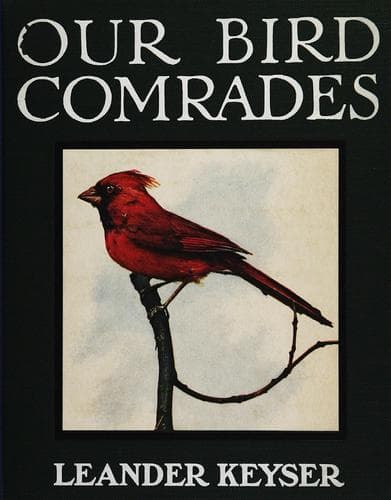
Our Bird ComradesKeyser, Leander S. (Leander Sylvester)
History
Our Bird Comrades
Keyser, Leander S. (Leander Sylvester)
Birds
I have said that these birds are scarcely known east of the Mississippi
River, but Mr. Ridgway says that they are occasionally seen during
migration in Illinois and Wisconsin. In eastern Kansas and western
Missouri they are common, almost abundant, during both the vernal and
autumnal migrations, and after you have once cultivated their
acquaintance they are likable, if not quite companionable, birds. But
familiar as they are in the regions named, they are still something of
a mystery to the naturalists of our country, for Mr. Ridgway says that
their "breeding range is unknown," save that there is a doubtful record
of one nest at Fort Custer, Montana; while Mrs. Bailey says: "The
breeding range of the Harris sparrow is unknown except for Mr. Preble's
Fort Churchill record. The last of July, among the dwarf spruces of
Fort Churchill, he found an adult male and female with young just from
the nest." It will be remembered that Fort Churchill is away up on the
coast of the Hudson Bay. It is probable, therefore, that the nest of
the Harris sparrow has never been found by any of the naturalists of
America. Who would suppose that these birds, so numerous and so well
known in Kansas, would, in the breeding season, surround themselves
with such an air of mystery?
It was in Kansas, too, that I really came to know the Lincoln sparrow
and hear his song, although I had caught a few fleeting glimpses of him
in the East, and also in the neighborhood of Duluth, Minnesota. In the
Sunflower state his conduct was just about as inconsistent as it could
have been without being downright absurd. What do I mean by that?
Why, while he was as wild as a deer, he still came to town, flitting
about in the bushes of a vacant lot near my house, and even visiting
the fence between my yard and the adjoining one, hopping about on the
ground with one eye on the lookout for nits and worms and the other for
human disturbers. My attention was first drawn to him by hearing a
squeaky little trill in the vacant lot. But, my! how wary he was when
I went out to find him! The song bore some resemblance to that of the
house wren, but had not so rolling and gurgling a quality, and was
pitched to a slightly higher and finer key. For a long time he kept
himself ensconced in the thicket, trilling saucily at intervals, as if
daring me to find him if I could, and when I finally drove him out of
his hiding place, he darted off in a zigzag course to another bush
clump, into which he dropped in the greatest possible haste.
Public-domain text, read in full here on John Shaqi.
Reviews
Reviews
No reviews yet
Be the first to share your thoughts on this work.
Join the Discussion
Join the discussion
Sign in to leave a comment or review.
Sign InorCreate an account