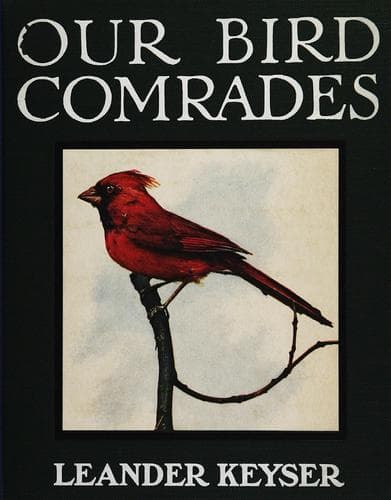
Our Bird ComradesKeyser, Leander S. (Leander Sylvester)
History
Our Bird Comrades
Keyser, Leander S. (Leander Sylvester)
Birds
By and by his curiosity got the better of him, and he flitted to the
top of a brush heap and peeped out at me surreptitiously. My glass was
upon him in a moment, revealing his whitish throat and mottled chest
washed with buff, the latter being his characteristic marking. A few
days later he was singing in a small apple tree by my neighbor's fence.
I stole as close to him as I could and peered at him through my
binocular, while he returned the compliment by peering at me, and then
warily ventured to rehearse his little tune. The least movement on my
part would startle him, cause him to flit to another perch and crane
out his neck to glare at me questioningly with wild, dilated eyes,
uncertain whether I was to be trusted or not. Both of us presently
grew tired of our strained position, and so I walked off and he flew
away. No doubt there was mutual satisfaction in the inspection we gave
each other; at least, I felt well satisfied with having heard the song
of so shy a bird. His stay in my neighborhood lasted only a few days;
then he left as mysteriously as he had come, without even the courtesy
of a good-bye. He went to his summer home in the North, and I did not
see him again until the next spring, just twelve months later almost to
the day.
WILDWOOD MINSTRELS*
* Parts of this and several other chapters of this book were first
published in The New York Times, whose courtesy in permitting him to
reprint, the author hereby acknowledges.
Nothing affords the bird student more pleasure than settling the identity
of species, albeit sometimes it is hard and patience-trying work. And of
all the birds, none are so provokingly and charmingly elusive as some of
the wood warblers. What a time I had for several years in making sure of
some of these little nymph-like creatures which were flitting about in
the foliage of the trees, concealing themselves by a leafy barrier! Many
a weary chase did they lead me through the woods, and more than once I
almost unjointed my neck by long-continued looking up.
For identifying the tree-top flitters an opera glass is scarcely powerful
enough. A field glass or a Bausch & Lomb binocular is really a
necessity. It draws the bird right down to you, while at the same time
the elusive creature remains at what it regards a safe distance. Its
conduct will therefore not be constrained, and the observer can study it
in its natural poses.
Public-domain text, read in full here on John Shaqi.
Reviews
Reviews
No reviews yet
Be the first to share your thoughts on this work.
Join the Discussion
Join the discussion
Sign in to leave a comment or review.
Sign InorCreate an account