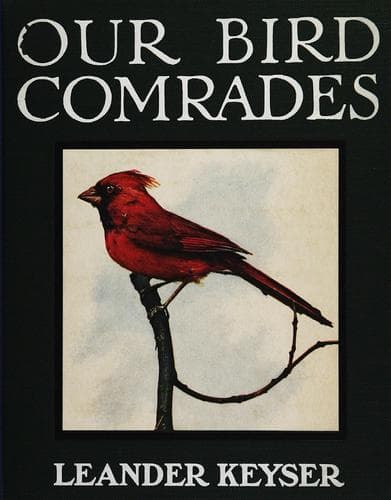
Our Bird ComradesKeyser, Leander S. (Leander Sylvester)
History
Our Bird Comrades
Keyser, Leander S. (Leander Sylvester)
Birds
The nesting habits of _caesia_ are quite similar to those of our
American forms, with the following interesting exception: The doorway
of the cavity constituting the bird's domicile is plastered up with
clay, made viscid by the nuthatch's glutinous saliva, leaving in the
center a circular hole just large enough to afford entrance and exit
for the little owner. Says the author quoted above: "When the sitting
bird is interfered with, she defends her treasures with great courage,
hissing like a wryneck, and vigorously striking at her aggressor with
her sharp bill." Like our common white-breast, the British bird may be
attracted to human dwellings by furnishing him a regular supply of food
suited to his taste, and may grow so trustful as to come when called,
and even to catch morsels thrown to him in the air. In the forest he
often hammers so loudly on a resonant branch that his tattoo is
mistaken for that of a woodpecker. The interior of the nest "contains
a bed of dry leaves, or the filmy flakes of the inner bark of a fir or
cedar, on which the eggs are laid."
In northern Europe another form of the nuthatch guild is found, known
scientifically as _Sitta europea_, whose under parts are white without
any washing of buff on the breast.
The Levant furnishes a most charming addition to the feathered
brotherhood now under consideration. The scientific gentlemen have
christened it _Sitta syriaca_, and its common name is the rock
nuthatch, an appellation that is most appropriate, for its chosen
haunts are rocky cliffs, over the faces of which it scuttles in the
most approved nuthatch fashion, head up or down, as the whim seizes it,
clinging with its sharp claws to the chinks, ledges, protuberances, and
rough surfaces of the rocky walls. A little larger than its European
cousin, its markings are quite similar. In Syria it is common as far
north as the southern shores of the Black Sea. Although somewhat shy,
it is described as having "sprightly manners and a clear, ringing
trill." Odd indeed are some of nature's evolutions, I had almost said
caprices, for the rock nuthatch is just as much at home and apparently
just as happy on its bleak precipices as is our merry whitebreast in
his umbrageous home in the oak or maple forest.
Public-domain text, read in full here on John Shaqi.
Reviews
Reviews
No reviews yet
Be the first to share your thoughts on this work.
Join the Discussion
Join the discussion
Sign in to leave a comment or review.
Sign InorCreate an account