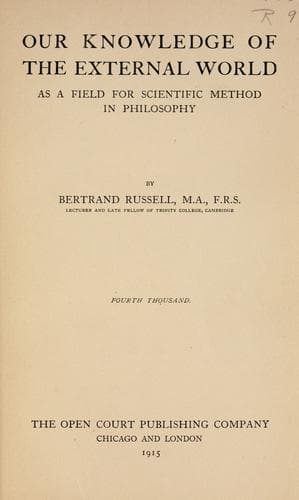
Our Knowledge of the External World as a Field for Scientific Method in Philosophy — John Shaqi
Our Knowledge of the External World as a Field for Scientific Method in PhilosophyRussell, Bertrand
Philosophy
Our Knowledge of the External World as a Field for Scientific Method in Philosophy
Russell, Bertrand
Knowledge, Theory of; Logical atomism
Evolutionism, in one form or another, is the prevailing creed of our
time. It dominates our politics, our literature, and not least our
philosophy. Nietzsche, pragmatism, Bergson, are phases in its
philosophic development, and their popularity far beyond the circles of
professional philosophers shows its consonance with the spirit of the
age. It believes itself firmly based on science, a liberator of hopes,
an inspirer of an invigorating faith in human power, a sure antidote to
the ratiocinative authority of the Greeks and the dogmatic authority of
mediæval systems. Against so fashionable and so agreeable a creed it may
seem useless to raise a protest; and with much of its spirit every
modern man must be in sympathy. But I think that, in the intoxication of
a quick success, much that is important and vital to a true
understanding of the universe has been forgotten. Something of Hellenism
must be combined with the new spirit before it can emerge from the
ardour of youth into the wisdom of manhood. And it is time to remember
that biology is neither the only science, nor yet the model to which all
other sciences must adapt themselves. Evolutionism, as I shall try to
show, is not a truly scientific philosophy, either in its method or in
the problems which it considers. The true scientific philosophy is
something more arduous and more aloof, appealing to less mundane hopes,
and requiring a severer discipline for its successful practice.
Darwin's _Origin of Species_ persuaded the world that the difference
between different species of animals and plants is not the fixed,
immutable difference that it appears to be. The doctrine of natural
kinds, which had rendered classification easy and definite, which was
enshrined in the Aristotelian tradition, and protected by its supposed
necessity for orthodox dogma, was suddenly swept away for ever out of
the biological world. The difference between man and the lower animals,
which to our human conceit appears enormous, was shown to be a gradual
achievement, involving intermediate beings who could not with certainty
be placed either within or without the human family. The sun and planets
had already been shown by Laplace to be very probably derived from a
primitive more or less undifferentiated nebula. Thus the old fixed
landmarks became wavering and indistinct, and all sharp outlines were
blurred. Things and species lost their boundaries, and none could say
where they began or where they ended.
Public-domain text, read in full here on John Shaqi.
Reviews
Reviews
No reviews yet
Be the first to share your thoughts on this work.
Join the Discussion
Join the discussion
Sign in to leave a comment or review.
Sign InorCreate an account