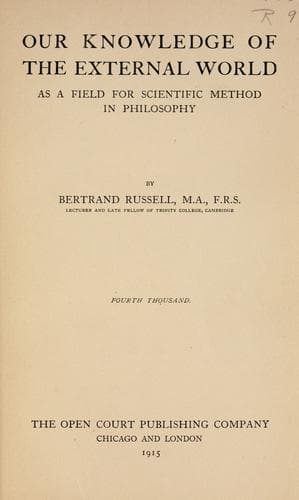
Our Knowledge of the External World as a Field for Scientific Method in Philosophy — John Shaqi
Our Knowledge of the External World as a Field for Scientific Method in PhilosophyRussell, Bertrand
Philosophy
Our Knowledge of the External World as a Field for Scientific Method in Philosophy
Russell, Bertrand
Knowledge, Theory of; Logical atomism
The first extension was the introduction of the inductive method by
Bacon and Galileo--by the former in a theoretical and largely mistaken
form, by the latter in actual use in establishing the foundations of
modern physics and astronomy. This is probably the only extension of the
old logic which has become familiar to the general educated public. But
induction, important as it is when regarded as a method of
investigation, does not seem to remain when its work is done: in the
final form of a perfected science, it would seem that everything ought
to be deductive. If induction remains at all, which is a difficult
question, it will remain merely as one of the principles according to
which deductions are effected. Thus the ultimate result of the
introduction of the inductive method seems not the creation of a new
kind of non-deductive reasoning, but rather the widening of the scope of
deduction by pointing out a way of deducing which is certainly not
syllogistic, and does not fit into the mediæval scheme.
The question of the scope and validity of induction is of great
difficulty, and of great importance to our knowledge. Take such a
question as, "Will the sun rise to-morrow?" Our first instinctive
feeling is that we have abundant reason for saying that it will, because
it has risen on so many previous mornings. Now, I do not myself know
whether this does afford a ground or not, but I am willing to suppose
that it does. The question which then arises is: What is the principle
of inference by which we pass from past sunrises to future ones? The
answer given by Mill is that the inference depends upon the law of
causation. Let us suppose this to be true; then what is the reason for
believing in the law of causation? There are broadly three possible
answers: (1) that it is itself known _a priori_; (2) that it is a
postulate; (3) that it is an empirical generalisation from past
instances in which it has been found to hold. The theory that causation
is known _a priori_ cannot be definitely refuted, but it can be rendered
very unplausible by the mere process of formulating the law exactly, and
thereby showing that it is immensely more complicated and less obvious
than is generally supposed. The theory that causation is a postulate,
_i.e._ that it is something which we choose to assert although we know
that it is very likely false, is also incapable of refutation; but it is
plainly also incapable of justifying any use of the law in inference. We
are thus brought to the theory that the law is an empirical
generalisation, which is the view held by Mill.
Public-domain text, read in full here on John Shaqi.
Reviews
Reviews
No reviews yet
Be the first to share your thoughts on this work.
Join the Discussion
Join the discussion
Sign in to leave a comment or review.
Sign InorCreate an account