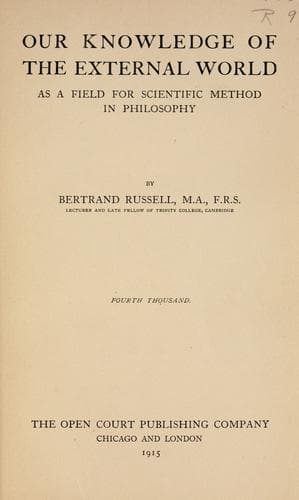
Our Knowledge of the External World as a Field for Scientific Method in PhilosophyRussell, Bertrand
Philosophy
Our Knowledge of the External World as a Field for Scientific Method in Philosophy
Russell, Bertrand
Knowledge, Theory of; Logical atomism
Mathematical logic, even in its most modern form, is not _directly_ of
philosophical importance except in its beginnings. After the beginnings,
it belongs rather to mathematics than to philosophy. Of its beginnings,
which are the only part of it that can properly be called
_philosophical_ logic, I shall speak shortly. But even the later
developments, though not directly philosophical, will be found of great
indirect use in philosophising. They enable us to deal easily with more
abstract conceptions than merely verbal reasoning can enumerate; they
suggest fruitful hypotheses which otherwise could hardly be thought of;
and they enable us to see quickly what is the smallest store of
materials with which a given logical or scientific edifice can be
constructed. Not only Frege's theory of number, which we shall deal with
in Lecture VII., but the whole theory of physical concepts which will be
outlined in our next two lectures, is inspired by mathematical logic,
and could never have been imagined without it.
In both these cases, and in many others, we shall appeal to a certain
principle called "the principle of abstraction." This principle, which
might equally well be called "the principle which dispenses with
abstraction," and is one which clears away incredible accumulations of
metaphysical lumber, was directly suggested by mathematical logic, and
could hardly have been proved or practically used without its help. The
principle will be explained in our fourth lecture, but its use may be
briefly indicated in advance. When a group of objects have that kind of
similarity which we are inclined to attribute to possession of a common
quality, the principle in question shows that membership of the group
will serve all the purposes of the supposed common quality, and that
therefore, unless some common quality is actually known, the group or
class of similar objects may be used to replace the common quality,
which need not be assumed to exist. In this and other ways, the indirect
uses of even the later parts of mathematical logic are very great; but
it is now time to turn our attention to its philosophical foundations.
Public-domain text, read in full here on John Shaqi.
Reviews
Reviews
No reviews yet
Be the first to share your thoughts on this work.
Join the Discussion
Join the discussion
Sign in to leave a comment or review.
Sign InorCreate an account