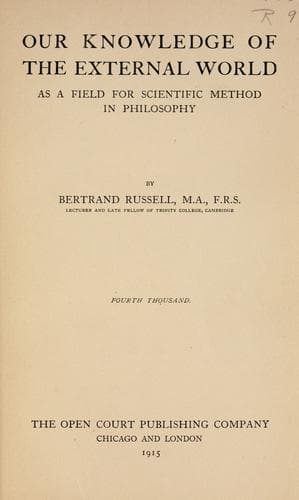
Our Knowledge of the External World as a Field for Scientific Method in PhilosophyRussell, Bertrand
Philosophy
Our Knowledge of the External World as a Field for Scientific Method in Philosophy
Russell, Bertrand
Knowledge, Theory of; Logical atomism
One brief example may suffice to illustrate Mr Bradley's method. The
world appears to be full of many things with various relations to each
other--right and left, before and after, father and son, and so on. But
relations, according to Mr Bradley, are found on examination to be
self-contradictory and therefore impossible. He first argues that, if
there are relations, there must be qualities between which they hold.
This part of his argument need not detain us. He then proceeds:
"But how the relation can stand to the qualities is, on the other side,
unintelligible. If it is nothing to the qualities, then they are not
related at all; and, if so, as we saw, they have ceased to be qualities,
and their relation is a nonentity. But if it is to be something to them,
then clearly we shall require a _new_ connecting relation. For the
relation hardly can be the mere adjective of one or both of its terms;
or, at least, as such it seems indefensible. And, being something
itself, if it does not itself bear a relation to the terms, in what
intelligible way will it succeed in being anything to them? But here
again we are hurried off into the eddy of a hopeless process, since we
are forced to go on finding new relations without end. The links are
united by a link, and this bond of union is a link which also has two
ends; and these require each a fresh link to connect them with the old.
The problem is to find how the relation can stand to its qualities, and
this problem is insoluble."[4]
[4] _Appearance and Reality_, pp. 32-33.
I do not propose to examine this argument in detail, or to show the
exact points where, in my opinion, it is fallacious. I have quoted it
only as an example of method. Most people will admit, I think, that it
is calculated to produce bewilderment rather than conviction, because
there is more likelihood of error in a very subtle, abstract, and
difficult argument than in so patent a fact as the interrelatedness of
the things in the world. To the early Greeks, to whom geometry was
practically the only known science, it was possible to follow reasoning
with assent even when it led to the strangest conclusions. But to us,
with our methods of experiment and observation, our knowledge of the
long history of _a priori_ errors refuted by empirical science, it has
become natural to suspect a fallacy in any deduction of which the
conclusion appears to contradict patent facts. It is easy to carry such
suspicion too far, and it is very desirable, if possible, actually to
discover the exact nature of the error when it exists. But there is no
doubt that what we may call the empirical outlook has become part of
most educated people's habit of mind; and it is this, rather than any
definite argument, that has diminished the hold of the classical
tradition upon students of philosophy and the instructed public
generally.
Public-domain text, read in full here on John Shaqi.
Reviews
Reviews
No reviews yet
Be the first to share your thoughts on this work.
Join the Discussion
Join the discussion
Sign in to leave a comment or review.
Sign InorCreate an account