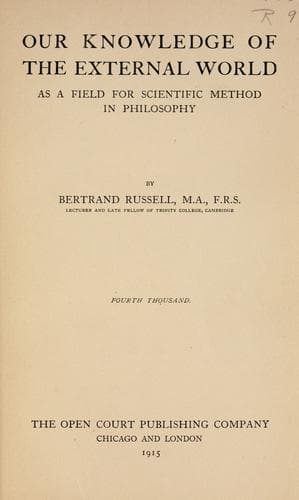
Our Knowledge of the External World as a Field for Scientific Method in PhilosophyRussell, Bertrand
Philosophy
Our Knowledge of the External World as a Field for Scientific Method in Philosophy
Russell, Bertrand
Knowledge, Theory of; Logical atomism
The function of logic in philosophy, as I shall try to show at a later
stage, is all-important; but I do not think its function is that which
it has in the classical tradition. In that tradition, logic becomes
constructive through negation. Where a number of alternatives seem, at
first sight, to be equally possible, logic is made to condemn all of
them except one, and that one is then pronounced to be realised in the
actual world. Thus the world is constructed by means of logic, with
little or no appeal to concrete experience. The true function of logic
is, in my opinion, exactly the opposite of this. As applied to matters
of experience, it is analytic rather than constructive; taken _a
priori_, it shows the possibility of hitherto unsuspected alternatives
more often than the impossibility of alternatives which seemed _primâ
facie_ possible. Thus, while it liberates imagination as to what the
world _may_ be, it refuses to legislate as to what the world _is_. This
change, which has been brought about by an internal revolution in logic,
has swept away the ambitious constructions of traditional metaphysics,
even for those whose faith in logic is greatest; while to the many who
regard logic as a chimera the paradoxical systems to which it has given
rise do not seem worthy even of refutation. Thus on all sides these
systems have ceased to attract, and even the philosophical world tends
more and more to pass them by.
One or two of the favourite doctrines of the school we are considering
may be mentioned to illustrate the nature of its claims. The universe,
it tells us, is an "organic unity," like an animal or a perfect work of
art. By this it means, roughly speaking, that all the different parts
fit together and co-operate, and are what they are because of their
place in the whole. This belief is sometimes advanced dogmatically,
while at other times it is defended by certain logical arguments. If it
is true, every part of the universe is a microcosm, a miniature
reflection of the whole. If we knew ourselves thoroughly, according to
this doctrine, we should know everything. Common sense would naturally
object that there are people--say in China--with whom our relations are
so indirect and trivial that we cannot infer anything important as to
them from any fact about ourselves. If there are living beings in Mars
or in more distant parts of the universe, the same argument becomes even
stronger. But further, perhaps the whole contents of the space and time
in which we live form only one of many universes, each seeming to itself
complete. And thus the conception of the necessary unity of all that is
resolves itself into the poverty of imagination, and a freer logic
emancipates us from the strait-waistcoated benevolent institution which
idealism palms off as the totality of being.
Public-domain text, read in full here on John Shaqi.
Reviews
Reviews
No reviews yet
Be the first to share your thoughts on this work.
Join the Discussion
Join the discussion
Sign in to leave a comment or review.
Sign InorCreate an account