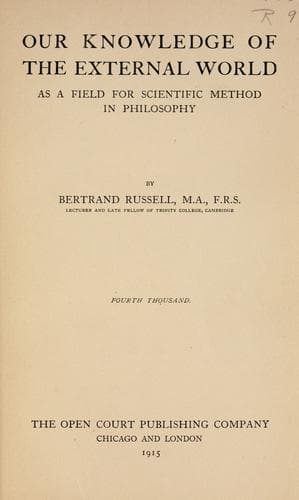
Our Knowledge of the External World as a Field for Scientific Method in Philosophy — John Shaqi
Our Knowledge of the External World as a Field for Scientific Method in PhilosophyRussell, Bertrand
Philosophy
Our Knowledge of the External World as a Field for Scientific Method in Philosophy
Russell, Bertrand
Knowledge, Theory of; Logical atomism
Another very important doctrine held by most, though not all, of the
school we are examining is the doctrine that all reality is what is
called "mental" or "spiritual," or that, at any rate, all reality is
dependent for its existence upon what is mental. This view is often
particularised into the form which states that the relation of knower
and known is fundamental, and that nothing can exist unless it either
knows or is known. Here again the same legislative function is ascribed
to _a priori_ argumentation: it is thought that there are contradictions
in an unknown reality. Again, if I am not mistaken, the argument is
fallacious, and a better logic will show that no limits can be set to
the extent and nature of the unknown. And when I speak of the unknown, I
do not mean merely what we personally do not know, but what is not known
to any mind. Here as elsewhere, while the older logic shut out
possibilities and imprisoned imagination within the walls of the
familiar, the newer logic shows rather what may happen, and refuses to
decide as to what _must_ happen.
The classical tradition in philosophy is the last surviving child of two
very diverse parents: the Greek belief in reason, and the mediæval
belief in the tidiness of the universe. To the schoolmen, who lived amid
wars, massacres, and pestilences, nothing appeared so delightful as
safety and order. In their idealising dreams, it was safety and order
that they sought: the universe of Thomas Aquinas or Dante is as small
and neat as a Dutch interior. To us, to whom safety has become monotony,
to whom the primeval savageries of nature are so remote as to become a
mere pleasing condiment to our ordered routine, the world of dreams is
very different from what it was amid the wars of Guelf and Ghibelline.
Hence William James's protest against what he calls the "block universe"
of the classical tradition; hence Nietzsche's worship of force; hence
the verbal bloodthirstiness of many quiet literary men. The barbaric
substratum of human nature, unsatisfied in action, finds an outlet in
imagination. In philosophy, as elsewhere, this tendency is visible; and
it is this, rather than formal argument, that has thrust aside the
classical tradition for a philosophy which fancies itself more virile
and more vital.
B. Evolutionism
Public-domain text, read in full here on John Shaqi.
Reviews
Reviews
No reviews yet
Be the first to share your thoughts on this work.
Join the Discussion
Join the discussion
Sign in to leave a comment or review.
Sign InorCreate an account