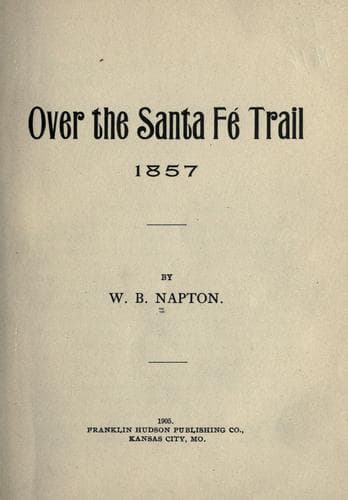
Over the Santa Fé Trail, 1857Napton, William Barclay
History
Over the Santa Fé Trail, 1857
Napton, William Barclay
Santa Fe National Historic Trail
It had been agreed between the wagonmasters that we would not make the
usual noonday halt that day, but would drive by the Indian camps and
as far beyond as it was possible for the cattle to stand the travel. We
had anticipated a great throng of Indians, and here they came by the
hundreds!
Some of the “big men” among them had guns or pistols, but the greater
number, in fact almost every one, had a bow and quiver of arrows slung
over his shoulders, even the children who looked not over ten years
old. One chief wore a complete outfit of blue, with the insignia of
a captain of the United States army, and had a Colt’s revolver, but
nearly all of them were naked to the waist, with a breech-clout and a
sort of kilt of buckskin around the loins, hanging down nearly to the
knees. Some wore moccasins, while many were barefooted.
The little fellows, nude, save for a breech-clout, had little bows
about a foot long, with arrows of cactus thorn, with which they would
shoot grasshoppers and other insects, showing astonishing skill.
Numbers of the warriors carried spears, with long handles, glittering
in the sunlight as they rode along, giving the caravan the appearance
of a vast army of Crusaders on the march to the Holy Land.
Captain Chiles, endeavoring to shift the responsibility and escape the
annoyance of the Indians, pointed to Reece, on his fine horse, and
said: “There is the captain; talk to him. Ask him for what you want.”
But they could not be so easily deceived. It is said that you cannot
fool Indians in this particular; that they never fail to distinguish
the wagonmaster, and appear to select the chief of any crowd or caravan
intuitively.
As we were traveling along the Indians gave frequent exhibitions of
the speed of their horses, running races with each other, but at a
sufficient distance not to frighten or stampede our cattle. The younger
men kept up a continual chattering and laughing; horse racing seemed
their great amusement. The young fellows of the visit renewed their
invitation, urging me to join them in a buffalo chase, explaining that
the herds were not far off, and expressing a great desire to see a
trial of my buffalo horse in a chase with theirs. I again declined.
The train was continually moving and would not be stopped to suit my
convenience, and there were other reasons, not unreasonably discreet.
The head men of the tribes, addressing the wagonmasters, complained
that they were in great need of supplies, owing to the delay in the
arrival of their annuities, and asked a gift from the two trains. The
two wagonmasters, after some demurring, proposed to them that if they,
with all their people, would withdraw from, and cease to follow the
train, and desist from annoying us, after we had corralled, we would go
into camp and give them such supplies as we could spare.
Public-domain text, read in full here on John Shaqi.
Reviews
Reviews
No reviews yet
Be the first to share your thoughts on this work.
Join the Discussion
Join the discussion
Sign in to leave a comment or review.
Sign InorCreate an account