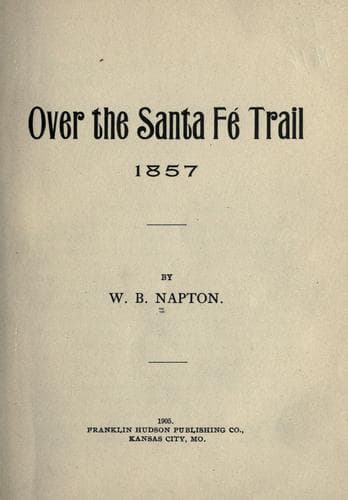
Over the Santa Fé Trail, 1857Napton, William Barclay
History
Over the Santa Fé Trail, 1857
Napton, William Barclay
Santa Fe National Historic Trail
To this proposition the chiefs agreed. One of the leaders began talking
in a loud voice to the multitude, gradually riding off from us, the
crowd following. Reaching a knoll which elevated him so that he could
overlook them, he dismounted and proceeded to make a speech. They
seemed a little slow about leaving, the multitude appearing to be not
altogether governed by the leaders, but nearly all finally withdrew
in the direction of their own camp. Driving on a few hundred yards
further, our corrals were formed and the cattle were driven off some
distance for water, while preparations were made for cooking dinner.
In a little while the chiefs, representing both tribes, made their
appearance at our corral, where the wagonmasters of both trains had met
to hold the diplomatic conference to determine how much of a gift of
supplies they were expecting from us.
The Indian chiefs dismounted from their horses, walked into the corral
and sat down on the ground, in the semi-circle, to the number of
perhaps a dozen and were soon joined by the wagonmasters, together with
our interpreter Juan.
Writing now, in the year 1901, solely from memory, forty-three years
since this scene occurred, I am unable to recollect all that was said,
or the names of any of the Indians who were present and took part in
this parley. No doubt San Tanta, that famous Kiowa chief, was among
them, but I took no notes whatever of this journey, and am forced
now to rely entirely on my memory. I recall that it was stated that
one of the most influential of the Comanche chiefs who was there was
an out-and-out Spaniard or Mexican, speaking the Indian language as
well as anybody, and was generally known and recognized as among the
meanest, most cruel and blood thirsty of the Comanche tribe. One of
the elder looking Indians produced a big pipe, filled it with tobacco,
lighted it, and after taking a few puffs himself passed it to the one
next to him. Thus the pipe was passed around to each one in the circle
until all had taken part in the smoke. The Indians were dignified,
discreet and cautious, as appeared to me during the conference, leaving
the impression that our troubles with them were about to terminate, and
this proved to be the fact.
At the close, and as a result of the council, a half-dozen sacks of
flour, half that many sacks of sugar, and a lot of sides of bacon were
brought forth from the mess wagons and stacked up on the ground, near
where the collection of dignitaries of the prairies were sitting,
smoking the pipe of peace and good fellowship.
I thought the Indians regarded the things we were giving them, as a
sort of tribute we were under obligations to pay for the privilege of
passing through their country unmolested.
Pack mules were brought up, the supplies were loaded on them and they
departed in the direction of the general camp, those engaged in the
conference soon following.
Public-domain text, read in full here on John Shaqi.
Reviews
Reviews
No reviews yet
Be the first to share your thoughts on this work.
Join the Discussion
Join the discussion
Sign in to leave a comment or review.
Sign InorCreate an account