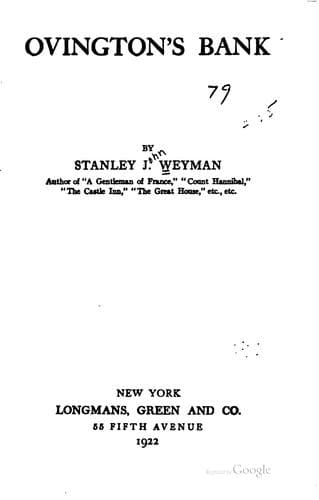
Banks and banking -- Fiction; England -- Social life and customs -- 19th century -- Fiction; Love stories
“But I’m older than you, and oh, dear, dear, I’ve known what
disappointment is! I remember when your father thought that he had the
promise of the Benthall living and we bought the drawing-room carpet,
though it was blue and buff and your father did not like the
color—something to do with a fox, I remember, though to be sure a fox
is red! Well, my dear,” drumming with her fingers on her lap in a
placid way that maddened her listener, “he was just as confident as you
are, and after all the Bishop gave the living to his own cousin, and
the money thrown clean away, and the carpet too large for any room we
had, and woven of one piece so that we couldn’t cut it! I’m sure that
was a lesson to me that there’s many a slip between the cup and the
lip. Believe me, a bird in the hand——”
“But this is in the hand!” Arthur cried, restraining himself with
difficulty. “This is in the hand!”
“Well, I don’t know how that may be. I never was a business woman,
whatever your uncle may say when he is in his tantrums. But I do know
that your father told me, nine or ten times——”
“And you’ve told me a hundred times!”
“Well, and I’m sure your uncle would say the same! But, indeed, I don’t
know what he wouldn’t say if he knew what we were thinking of!”
“The truth is, mother, you are afraid of the Squire.”
“And if I am,” plaintively, “it is all very well for you, Arthur, who
are away six days out of seven. But I’m here and he’s here. And I have
to listen to him. And if this money is lost——”
“But it cannot be lost, I tell you!”
“Well, if it is lost, we shall both be beggars! Oh, dear, dear, I’m
sure if your father told me once he told me a hundred times——”
“Damn!” Arthur cried, fairly losing his temper at last. “The truth is,
mother, that my father knew nothing about money.”
At that, however, Mrs. Bourdillon began to cry and Arthur found himself
obliged to drop the matter for the time. He saw, too, that he was on
the wrong tack, and a few days later, under pressure of necessity, he
tried another. He humbled himself, he wheedled, he cajoled; and when he
had by this means got on the right side of his mother he spoke of
Ovington’s success.
“In a few years he will be worth a quarter of a million,” he said.
The figure flustered her. “Why, that’s——”
“A quarter of a million,” he repeated impressively. “And that’s why I
consider this the chance of my life, mother. It is such an opportunity
as I shall never have again. It is within my reach now, and surely,
surely,” his voice shook with the fervor of his pleading, “you will not
be the one to dash it from my lips?” He laid his hand upon her wrist.
“And ruin your son’s life, mother?”
She was shaken. “You know, if I thought it was for your good!”
“It is! It is, mother!”
“I’d do anything to make you happy, Arthur! But I don’t believe,” with
a sigh, “that whatever I did your uncle would pay the money.”
“Is it his money or yours?”
Public-domain text, read in full here on John Shaqi.
Reviews
Reviews
No reviews yet
Be the first to share your thoughts on this work.
Join the Discussion
Join the discussion
Sign in to leave a comment or review.
Sign InorCreate an account