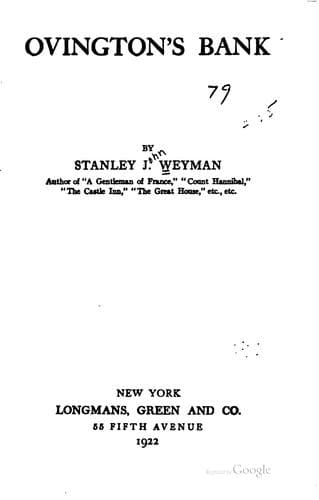
Banks and banking -- Fiction; England -- Social life and customs -- 19th century -- Fiction; Love stories
“Why, of course, Arthur, I thought that you knew that it was your
father’s.” She was very simple, and her pride was touched.
“And now it is yours. And I suppose that some day—I hope it will be a
long day, mother—it will be mine. Believe me, you’ve only to write to
my uncle and tell him that you have decided to call it up, and he will
pay it as a matter of course. Shall I write the letter for you to
sign?”
Mrs. Bourdillon looked piteously at him. She was very, very unwilling
to comply, but what was she to do? Between love of him and fear of the
Squire, what was she to do? Poor woman, she did not know. But he was
with her, the Squire was absent, and she was about to acquiesce when a
last argument occurred to her. “But you are forgetting,” she said, “if
your uncle takes offence, and I’m sure he will, he’ll come between you
and Josina.”
“Well, that is his look-out.”
“Arthur! You don’t mean that you’ve changed your mind, and you so fond
of her? And the girl heir to Garth and all her father’s money!”
“I say nothing about it,” Arthur declared. “If he chooses to come
between us that will be his doing, not mine.”
“But Garth!” Mrs. Bourdillon was altogether at sea. “My dear boy, you
are not thinking! Why, Lord ha’ mercy on us, where would you find such
another, young and pretty and all, and Garth in her pocket? Why, if it
were only on Jos’s account you’d be mad to quarrel with him.”
“I’m not going to quarrel with him,” Arthur replied sullenly. “If he
chooses to quarrel with me, well, she’s not the only heiress in the
world.”
His mother held up her hands. “Oh dear me,” she said wearily. “I give
it up, I don’t understand you. But I’m only a woman and I suppose I
don’t understand anything.”
He was accustomed to command and she to be guided. He saw that she was
wavering, and he plied her afresh, and in the end, though not without
another outburst of tears, he succeeded. He fetched the pen, he
smoothed the paper, and before he handed his mother her bed-candle he
had got the fateful letter written, and had even by lavishing on her
unusual signs of affection brought a smile to her face. “It will be all
right, mother, you’ll see,” he urged as he watched her mount the
stairs. “It will be all right! You’ll see me a millionaire yet.”
And then he made a mistake which was to cost him dearly. He left the
letter on the mantel-shelf. An hour later, when he had been some time
in bed, he heard a door open and he sat up and listened. Even then, had
he acted on the instant, it might have availed. But he hesitated,
arguing down his misgivings, and it was only when he caught the sound
of footsteps stealthily re-ascending that he jumped out of bed and lit
a candle. He slipped downstairs, but he was too late. The letter was
gone.
He went up to bed again, and though he wondered at the queer ways of
women he did not as yet doubt the issue. He would recover the letter in
the morning and send it. The end would be the same.
Public-domain text, read in full here on John Shaqi.
Reviews
Reviews
No reviews yet
Be the first to share your thoughts on this work.
Join the Discussion
Join the discussion
Sign in to leave a comment or review.
Sign InorCreate an account