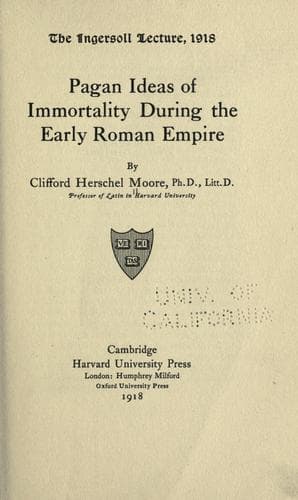
Pagan Ideas of Immortality During the Early Roman EmpireMoore, Clifford Herschel
Religion
Pagan Ideas of Immortality During the Early Roman Empire
Moore, Clifford Herschel
Immortality; Rome -- Religion
The devotees of these gods formed sacred communities, admission to which
was obtained by secret initiation; the rituals were mysteries in which
the devotee had pictured to him, or himself acted out, the sacred drama,
whereby he received assurance of divine protection here and of a happy
immortality hereafter. The initiate, moreover, was believed to
experience a new birth and to enter into union with his god, so that he
became Osiris-Serapis, or Attis, or Mithras, even as the Dionysiac
devotee became a Bacchus.
To the question how the comforting assurance of present safety and of
future immortality was given the initiate, we can return no more
satisfactory answer than we can make in the case of the Greek mysteries;
yet we may get some hint from the words which the Latin writer,
Apuleius, puts into the mouth of his hero, Lucius, who was initiated
into the rites of Isis. This is all that he might tell: “I approached
the bounds of death. I trod the threshold of Proserpina. I was carried
through all the elements and returned again to the upper air. At dead of
night I saw the sun glowing with a brilliant light. The gods of heaven
and of hell I approached in very person and worshipped face to
face.”[30] Obscure as these words are, much is plain. In some way the
devotee was made to believe that he, like Virgil’s hero, had passed
through the world of the dead and had been born again into a new life;
he had touched the elements--earth, air, water, and fire, the very
foundations of the visible cosmos; he had seen the sun which ever shines
on the consecrated; and he had been granted the beatific vision.
Therefore he knew that his salvation was secure forever.
Furthermore in these mystery religions preparation for the emotional
experiences of initiation was made by means of lustral baths, fasting,
abstinence, and penance; once consecrated, the devotee supported his
religious life by following a prescribed regimen and by participating in
frequent holy offices; degrees of initiation and grades of office marked
his advance in faithful proficiency; while magic words and formulae,
committed to memory, assured him a safe passage from this world to the
next.
The oriental mysteries enjoyed a widespread popularity, except in
Greece, under the Roman Empire down to the latter half of the third
century. Then they began to lose their hold in the Roman provinces
before the growing power of Christianity; yet in the city of Rome they
stubbornly held their ground until the end of the fourth century. The
first St. Peter’s was built hard beside a shrine of the Great Mother of
the Gods; there for three-quarters of a century the old and the new
mysteries strove in conscious rivalry, until at last Cybele was forced
to yield to Christ.
Public-domain text, read in full here on John Shaqi.
Reviews
Reviews
No reviews yet
Be the first to share your thoughts on this work.
Join the Discussion
Join the discussion
Sign in to leave a comment or review.
Sign InorCreate an account