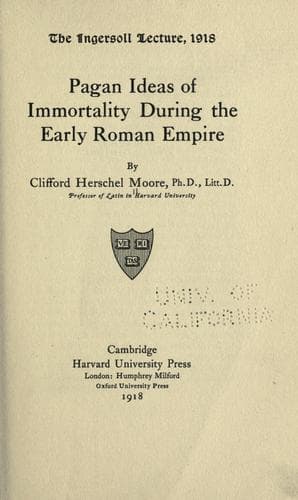
Pagan Ideas of Immortality During the Early Roman EmpireMoore, Clifford Herschel
Religion
Pagan Ideas of Immortality During the Early Roman Empire
Moore, Clifford Herschel
Immortality; Rome -- Religion
The last centuries before the birth of Jesus and the opening centuries
of our era were marked by an increasing religious longing and unrest,
first among the Greeks and then among the Romans. There was a weariness
and a dissatisfaction with the inherited forms of religious expression;
and many felt a sense of separation from God, of a gulf between the
human and the divine, which they hoped might be bridged by a direct
revelation, by a vision, which would grant immediate knowledge of God.
These eager desires led in part to an increase in superstition and
credulity, over which we need not now pause; in part to the resort to
the oriental mysteries of which I have just spoken; and in part to a
revival of Pythagorean mysticism and of mystic Platonism among the
intellectuals, who no longer felt that the reason and the will gave them
the assurance which they required.
The later mystic philosophies laid much stress on an ascetic discipline
in this life, to secure the soul’s purification, and all taught that the
great end of man was to attain to the knowledge of God, wherein lay
man’s supreme happiness. Such knowledge, it was thought, could come only
through a revelation. Here these philosophies agreed with the teaching
of the oriental mysteries, and indeed with popular belief as well. On
the question of the immortality of the soul, however, the later mystics
brought forward no new arguments. Plotinus, the greatest of the
Neoplatonists, virtually repeats the proofs adduced by the founder of
the Academy.[31] Undoubtedly during the opening centuries of the
Christian era there was a growing belief in the soul’s immortality, or
at least an increasing hope of a future life, but such hopes and
beliefs, outside Christianity, were not based on new arguments. Plato
had once for all in antiquity, supplied the philosophic grounds for
confidence. Only in modern times have new arguments of any weight been
adduced.
* * * * *
Public-domain text, read in full here on John Shaqi.
Reviews
Reviews
No reviews yet
Be the first to share your thoughts on this work.
Join the Discussion
Join the discussion
Sign in to leave a comment or review.
Sign InorCreate an account