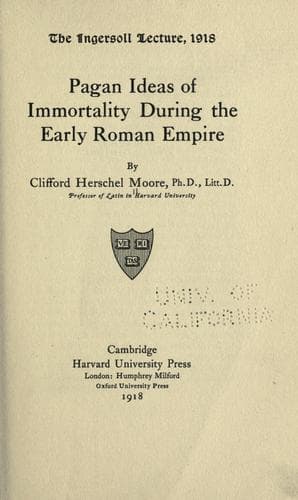
Pagan Ideas of Immortality During the Early Roman EmpireMoore, Clifford Herschel
Religion
Pagan Ideas of Immortality During the Early Roman Empire
Moore, Clifford Herschel
Immortality; Rome -- Religion
Let us now pause to summarize the results of the considerations which
have thus far occupied us. We may fairly say that, in spite of popular
doubt, intellectual scepticism, and philosophic denial, beliefs in some
kind of existence beyond the grave were widespread in the Greco-Roman
world at the beginning of our era. For many, probably for most, belief
did not advance beyond inherited intuitions, fears, or hopes, which were
fostered by tendance of the dead, prescribed by immemorial custom. Many,
both the simple and the learned, found their assurance in diverse forms
of Greek mysteries; others, again, strengthened to endure the buffetings
of this life by the resolute doctrines of Stoicism, were satisfied with
the extended, though limited, future existence vouchsafed the virtuous;
while the later Platonists, returning to the mystic Orphic-Pythagorean
elements which had influenced the founder of their school, offered
their disciples arguments in favor of a genuine immortality. Under the
Empire the supports of faith became more numerous and appealing. At the
lowest end of the scale were charlatans, as there had been since Plato’s
day,[32] who imposed on the fears and hopes of their victims for their
own mercenary ends. Higher were those inspiring Eastern mysteries which
were carried to the remotest provinces, binding their devotees by
initiation, ritual service, and a prescribed regimen, more constantly to
a religious life than Greek mysteries had ever done; and the great end
of all was the assurance that the souls of the faithful should not die,
but should mount to the upper heavens to be at one with God.
The last vital philosophy of antiquity was Neoplatonism, on which we
have just touched; the chief aim of the Neoplatonist also was to secure
union with the Divine, and his greatest article of faith was the soul’s
immortality. If this theosophic philosophy seem to any of poor account,
I would remind him that by Origen and Augustine Neoplatonism was brought
into Christian thought, where it has been operative ever since.
III
In view of the facts with which we have been occupied we shall not make
the error of thinking that Christianity brought the hope of immortality
among men, for, as we have seen, hope--nay, sure confidence, in the
soul’s survival was widespread throughout the ancient world when Jesus
began his ministry. What can we say of early Christian teaching, and how
was it related to its pagan environment?
Public-domain text, read in full here on John Shaqi.
Reviews
Reviews
No reviews yet
Be the first to share your thoughts on this work.
Join the Discussion
Join the discussion
Sign in to leave a comment or review.
Sign InorCreate an account