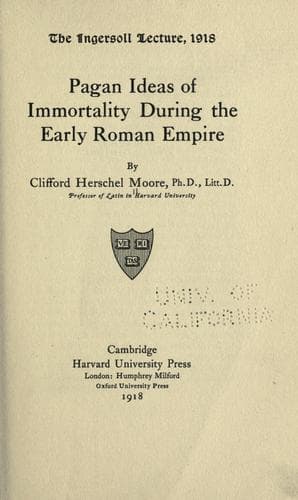
Pagan Ideas of Immortality During the Early Roman EmpireMoore, Clifford Herschel
Religion
Pagan Ideas of Immortality During the Early Roman Empire
Moore, Clifford Herschel
Immortality; Rome -- Religion
Christianity grew out of Judaism. Now it is a striking fact that the
Jews were later than most of the peoples about them in conceiving of
individual immortality.[33] Clinging to monotheism and absorbed in the
life of their nation, they had cut themselves off from some of the ideas
developed by their neighbors. To follow out the intricate and uncertain
history of eschatological ideas among the Jews would be too difficult
here. We may simply say that when Jesus began his ministry a
considerable part of the Jews had abandoned the expectation of a
material kingdom of God and looked forward to a spiritual kingdom on a
transformed earth or in heaven. In this kingdom those would share, who
through God’s grace and their own righteousness had won a place therein;
but the wicked were either to be punished forever or to be utterly
destroyed. To these ideas Jesus’ teaching was closely related, although
he gave a nobler meaning to Jewish doctrine, and he did not limit the
hope of a future existence so narrowly as some would do. Moreover, he
adopted from the law the teaching which made salvation and future
happiness depend on a love for God and for one’s fellow-men, which would
result in an unselfish life of righteousness. Salvation, he taught, was
a present experience, open to every man who conformed to the
requirement.
After the crucifixion of Jesus, the Apostles and their successors
naturally made his person, death, and resurrection the great means
through which his followers secured salvation. Paul, moreover, taught
that through faith--using the word in a somewhat unusual sense--the
believer secured the actual presence of Christ within him, entered into
a mystic union with the divine Saviour, by which the man was freed from
sin and reborn into a new spiritual life; this new life was confirmed by
the indwelling Holy Spirit which completed the man’s moral
regeneration. In the Fourth Gospel we find a similar doctrine of a
mystic union with Christ, secured by belief in Him as the incarnate
Word--a belief which brought about a spiritual rebirth and therewith
gave a present warrant of eternal life.[34]
It is unnecessary for our present purpose to examine the beliefs of the
earliest Christians as to the resurrection or the second coming of
Christ, which they expected to take place within their own time--these
beliefs and many others the Apostolic Church derived naturally from
their Jewish tradition and from the teachings of Jesus. I shall ask you
rather to focus your thought on the fundamental ideas of this early
Christianity: that is to say, on the revelation of God, the punishment
of sin by suffering or annihilation, the mystic union with the Divine,
and a happy immortality as a reward for faith and righteousness. Were
these ideas foreign to the peoples of the Mediterranean area? No, our
survey has reminded us that on the contrary they were familiar over wide
stretches of the Greco-Roman world.
Public-domain text, read in full here on John Shaqi.
Reviews
Reviews
No reviews yet
Be the first to share your thoughts on this work.
Join the Discussion
Join the discussion
Sign in to leave a comment or review.
Sign InorCreate an account