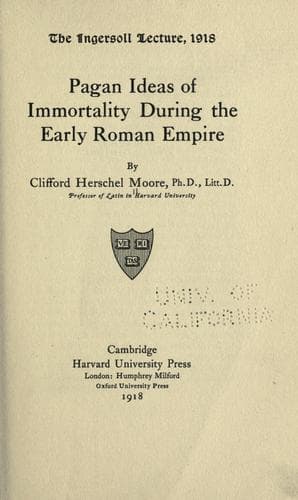
Pagan Ideas of Immortality During the Early Roman Empire — John Shaqi
Pagan Ideas of Immortality During the Early Roman EmpireMoore, Clifford Herschel
Religion
Pagan Ideas of Immortality During the Early Roman Empire
Moore, Clifford Herschel
Immortality; Rome -- Religion
Do not misunderstand me here. Of course I am not making the elementary
blunder of saying that because certain beliefs of the Christians and the
Pagans were similar, they therefore were identical, or that they were
derived from one another, or that the many factors of which they were
composed were the same. No one with any knowledge of the history of
religious thought could maintain that. But the point which I do wish to
emphasize is this, viz.: that the eschatological ideas widely current in
the Mediterranean world were such that Christianity found a favorable
environment when it began its proselyting work. This seems to me one of
the most significant facts in the relation of early Christianity to
paganism. The Christian teachings as to the means by which the assurance
of a happy immortality was to be secured could hardly seem very strange
at first hearing to any one who was familiar with mystery religions or
with much of the religious philosophy current in the pagan world during
the early Christian centuries. Closer examination would reveal
fundamental differences between Christian belief and the pagan hope. But
it is not insignificant that Christianity spread most rapidly at first
in Syria and Asia Minor, countries long familiar with those mystic
religions, which had promised what the nobler faith supplied.
IV
Although we now have examined the conditions which, to my mind, are the
most significant in the relation of pagan ideas of immortality to those
of early Christianity, there yet remain matters which, if less
important, are still of more than merely curious interest. We shall now
look at some of these questions.
What notions of heaven and of hell did the Greeks and Romans have? This
inquiry is often made. The reply is easily given. Man has always painted
hell and paradise after his own conception of suffering and of
happiness, just as truly as he has made God after his own image.
Consequently the ancient’s ideas of the future life ranged all the way
from the grossest materialistic concepts to highly spiritualized
beliefs. Plato in the Republic makes Adeimantus say that some seem to
think that an immortality of drunkenness is virtue’s highest meed.[35]
But Socrates conceived the future state to be something very different;
a place in which he could hold high discourse with the great ones of the
past.[36] In general, however, punishment and rewards were of a material
sort, for such are most easily imagined and understood. Has it been
otherwise with Christians? The answer is to be found in Christian
apocalypses, medieval monuments, renaissance art, and in our own minds.
Of course there developed in Greek thought what we might call an
orthodox geography and scheme for the other world, of which Virgil gives
us a just picture. Interesting as it might prove to examine the details
of this picture, we will rather turn to other matters.
Public-domain text, read in full here on John Shaqi.
Reviews
Reviews
No reviews yet
Be the first to share your thoughts on this work.
Join the Discussion
Join the discussion
Sign in to leave a comment or review.
Sign InorCreate an account