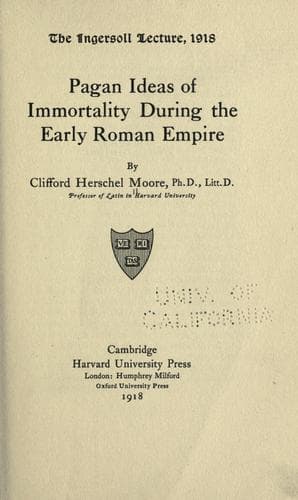
Pagan Ideas of Immortality During the Early Roman EmpireMoore, Clifford Herschel
Religion
Pagan Ideas of Immortality During the Early Roman Empire
Moore, Clifford Herschel
Immortality; Rome -- Religion
When Christianity spread among the Gentiles, it at once came under
influences which inevitably left their marks in its thought and
practice. Let me offer two illustrations.
Early in the hour I spoke of Aeneas’ journey through the lower world as
an initiation by which he was enlightened and strengthened for the great
task that lay before him; and we have now seen that in all the
mysteries, both Greek and oriental, there were initiatory rites, in
which the novice symbolically died to the old life and was born again
into a new existence. Moreover, through his emotional experience he
received assurance that his salvation was secure forever. The idea of
the new birth belongs to Christianity also from the first. Paul held
that it was brought about by faith; the author of the Fourth Gospel
taught that it was secured by love and belief. Baptism in primitive
Christianity was at first symbolical--an act of ritual purification,
which was believed to indicate the remission of sins and the bestowal of
the Holy Spirit.[37] But by the second century Christianity had become a
mystery in the Greek sense, into which the novice, after a period of
preparation, was duly initiated by baptism; and indeed the act was
believed to have a magic power to secure immortality, closely parallel
to that of the pagan initiation.[38] We all know that the
ecclesiastical confidence which such belief inspires is far from unknown
today.
Again you will recall that when Anchises’ shade was instructing Aeneas
in the meaning of life and death, he said:
“Nor when to life’s last beam they bid farewell
May sufferers cease from pain, nor quite be freed
From all their fleshly plagues; but by fixed law,
The strange, inveterate taint works deeply in.
For this, the chastisement of evils past
Is suffered here, and full requital paid.
Some hang on high, outstretched to viewless winds;
For some their sin’s contagion must be purged
In vast ablution of deep-rolling seas,
Or burned away in fire. Each man receives
His ghostly portion in the world of dark.”
Public-domain text, read in full here on John Shaqi.
Reviews
Reviews
No reviews yet
Be the first to share your thoughts on this work.
Join the Discussion
Join the discussion
Sign in to leave a comment or review.
Sign InorCreate an account