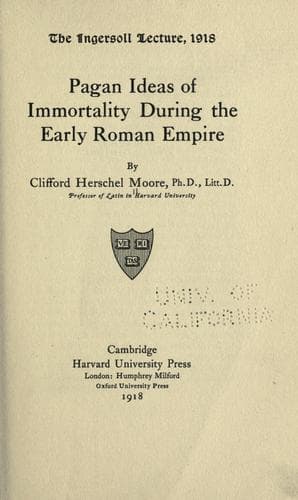
Pagan Ideas of Immortality During the Early Roman EmpireMoore, Clifford Herschel
Religion
Pagan Ideas of Immortality During the Early Roman Empire
Moore, Clifford Herschel
Immortality; Rome -- Religion
Naturally it does not follow that, because Rome’s greatest poet chose to
picture souls surviving their corporeal homes, the average man believed
in a future life, but there is abundant evidence that the poet was
appealing to widespread beliefs, when he wrote his apocalyptic book.[4]
In fact from the earliest times known to us, both Greeks and Romans held
to a belief in some kind of extended life for souls after the death of
the body.[5] Both peoples had their cults of the dead, rites of tendance
and of riddance, festivals both public and private, which leave no doubt
that the great majority of men never questioned that the spirits of the
departed existed after this life, and that those spirits were endowed
with power to harm or to bless the living.[6] But beyond this rather
elementary stage of belief the Romans never went of themselves. The
Greeks, however, began early to develop eschatological ideas which had,
and which still have, great importance.
The eleventh book of the Odyssey, as I have already said, is the oldest
“Descent to Hades” in European literature. The souls of the dead are
there represented as dwelling in the land of shadows, having no life,
but leading an insubstantial existence, without punishment or reward.
Such a future world could have no moral or other value; it could only
hang over men as a gloomy prospect of that which awaited them when the
suns of this world had forever set. But in the seventh and sixth
centuries B.C. other ideas came to the front, which were influential
throughout later history. In those two centuries fall the first period
of Greek individualism and a religious revival--two things not wholly
disconnected. The Orphic sect, which appeared in the sixth century, was
made up of religious devotees who adopted a purified form of the
religion of Dionysus.[7] The center of the Orphic faith and mystic
ceremonial was the myth of the birth, destruction, and rebirth of the
god. According to the story, Dionysus was pursued by the Titans, powers
hostile to Zeus. In his distress the god changed himself into various
creatures, finally taking on the form of a bull, which the Titans tore
in pieces and devoured. But the goddess Athena saved the heart and gave
it to Zeus who swallowed it. Hence sprang the new Dionysus. The Titans
Zeus destroyed with his thunderbolt and had the ashes scattered to the
winds. From these ashes, in one form of the myth, man was made, and
therefore he was thought to unite in his person the sinful Titanic
nature and the divine Dionysiac spark. The parallelism between this
story and the myths of Osiris, Attis, and Adonis is at once evident.
They are all gods who die and live again, and thus become lords of death
and life, through whom man gains assurance of his own immortality.
Public-domain text, read in full here on John Shaqi.
Reviews
Reviews
No reviews yet
Be the first to share your thoughts on this work.
Join the Discussion
Join the discussion
Sign in to leave a comment or review.
Sign InorCreate an account