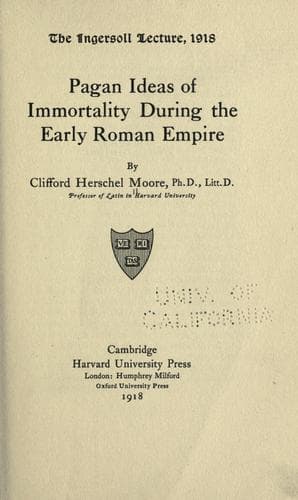
Pagan Ideas of Immortality During the Early Roman EmpireMoore, Clifford Herschel
Religion
Pagan Ideas of Immortality During the Early Roman Empire
Moore, Clifford Herschel
Immortality; Rome -- Religion
Our chief concern with the Orphics here is that they seem to have
introduced among the Greeks the idea that the soul of man was divine,
was a [Greek: daimôn] which had fallen, and for its punishment was
imprisoned in the body as in a tomb. In its corporeal cell it was
condemned to suffer defilement until released by death, when it passed
to Hades. Its lot there depended on its life on earth. As an Orphic
fragment says: “They who are righteous beneath the rays of the sun, when
they die, have a gentler lot in a fair meadow by deep flowing
Acheron.... But they who have worked wrong and insolence under the rays
of the sun are led down beneath Cocytus’s watery plain into chill
Tartarus.”[8] The soul’s sojourn in Hades therefore was a time of
punishment and of purification, even as life itself was a penance for
sin. According to a common belief, at least in Plato’s day, after a
thousand years the soul entered a new incarnation, and so on through ten
rounds of earth and Hades, until at last, freed from sin and earthly
dross by faithful observance of a holy life on earth and by the
purification which it underwent below, it returned to its divine abode;
but those who persisted in sin were condemned to all the punishments
which man’s imagination could devise; the wicked were doomed to lie in
mud and filth, while evil demons rent their vitals. Indeed the horrors
which the medieval Christian loved to depict in order to terrify the
wicked and to rejoice the faithful, were first devised by the Orphics
and their heirs, for exactly the same purpose.
But what bases did the Orphics find for their belief in the divine
nature of the soul? In their mythology they had said that man was
created out of the ashes of the Titans in which a spark of Dionysus
still remained. But in fact they seem to have rested on faith or
intuition, without working out clearly a philosophic answer. They were
indeed deeply conscious of man’s dual nature; they perceived that on the
one hand he is pulled by his baser instincts and desires, which they
naturally attributed to the body, and that on the other hand he is
prompted by nobler aspirations, which they assigned to his soul. This
higher part of man’s dual self was, for them, the Dionysiac element in
him. And man’s moral obligation they held to be to free this divine
element from the clogging weight of the body, to cease to “blind his
soul with clay.” So far as we are aware, the Orphics were the first
among the Greeks to make the divinity of the soul a motive for the
religious life, and perhaps the first to see that, if the soul is
divine, it may naturally be regarded as eternally so, and therefore as
immortal. What more momentous thoughts as to the soul’s nature and its
destiny could any sect have introduced than these? They were shared by
their contemporaries, the Pythagoreans; in fact it is hard to say with
certainty which sect developed these concepts first.[9]
Public-domain text, read in full here on John Shaqi.
Reviews
Reviews
No reviews yet
Be the first to share your thoughts on this work.
Join the Discussion
Join the discussion
Sign in to leave a comment or review.
Sign InorCreate an account