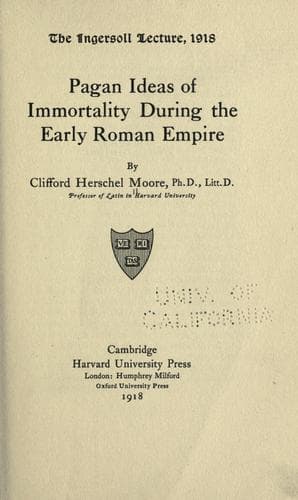
Pagan Ideas of Immortality During the Early Roman Empire — John Shaqi
Pagan Ideas of Immortality During the Early Roman EmpireMoore, Clifford Herschel
Religion
Pagan Ideas of Immortality During the Early Roman Empire
Moore, Clifford Herschel
Immortality; Rome -- Religion
But the Orphic-Pythagorean confidence in the immortality of the soul
was at the most only an emotional belief. It remained for Plato in the
early fourth century to give that belief a philosophic basis and thereby
to transform it into a reasonable article of religion. This he
fundamentally did, when he brought his concept of the reasoning soul
into connection with his doctrine of “forms” or “ideas.” He maintained
that behind this transient phenomenal world known to us through the
senses, lies another world, the world of ideas, invisible, permanent,
and real, which can be grasped by the reason only. These permanent
ideas, he said, are of various grades and degrees, the supreme idea
being that of the Good and the Beautiful, which is the cause of all
existence, truth, and knowledge; it at once comprehends these things
within itself and is superior to them; it is the Absolute, God.[10]
But all the ideas, including the Absolute, are, as I have just said,
apprehended not by man’s senses but by his intellect. Therefore, argues
Plato, man’s reasoning soul must have the same nature as the ideas; like
them, it must belong to the world above the senses and with them it must
partake of the Absolute. Moreover, since the ideas are eternal and
immortal, it inevitably follows that man’s reasoning soul has existed
from eternity and will exist forever.[11]
This is not the occasion to discuss the validity of Plato’s doctrine.
Aristotle stated, once for all, the fundamental objections to his
teacher’s views.[12] But we shall readily grant that, if we accept
Plato’s doctrine, his conclusions as to the immortality of the soul may
logically follow and that no further evidence is needed to convince us.
Yet Plato was not content to let the matter rest on this single
argument, for in other dialogues he adduces proofs which do not seem so
convincing to us as to their author. He attempts to prove immortality
from the self-motion of the soul, again from the dim recollections out
of an earlier existence which enable one to recall axiomatic truths or
to recognize relations, as in mathematics--things which one has never
learned in this present life. On another occasion he argues from the
unchanging nature of the soul and from the soul’s superiority to the
body. But he seems to have thought the most convincing proof was the
fact that the notion of life is inseparable from our concept of the
soul; that is, a dead soul is unthinkable. For all these reasons,
therefore, he argued that the soul must be immortal.[13]
Public-domain text, read in full here on John Shaqi.
Reviews
Reviews
No reviews yet
Be the first to share your thoughts on this work.
Join the Discussion
Join the discussion
Sign in to leave a comment or review.
Sign InorCreate an account