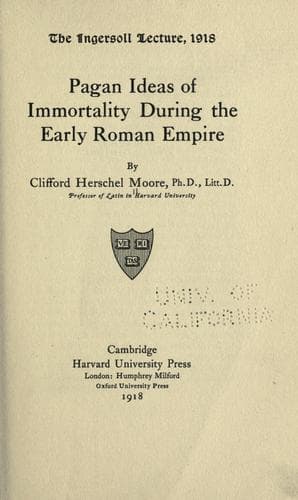
Pagan Ideas of Immortality During the Early Roman EmpireMoore, Clifford Herschel
Religion
Pagan Ideas of Immortality During the Early Roman Empire
Moore, Clifford Herschel
Immortality; Rome -- Religion
Whatever we may think of Plato’s different proofs, they have furnished
the armories of apologists almost down to our own day. In antiquity they
were constantly repeated, in whole or in part, not only by devoted
members of the Academy and later by the Neoplatonists, but by the
Eclectics and others, like Cicero in the first book of his Tusculan
Disputations, and at the close of Scipio’s Dream; they were borrowed by
the Stoics, and some eight hundred years after Plato had first
formulated them, they were employed by St. Augustine in his tract _De
Immortalitate Animae_. The religious intuition of the Orphic and
Pythagorean then was given a rational basis by Plato, and thus
supported, proved so convincing to antiquity that Plato’s views were the
most important of all in supporting belief in the soul’s immortality.
They were in large measure taken up by the Christian church, and, as has
been often shown, the doctrine of a spiritual immortality apart and free
from the body, was of immense service to primitive Christianity, when
the hope of the early return of Christ to found a new kingdom on earth
faded before the lengthening years.
To Plato himself his belief in immortality was of the greatest moment,
for the whole fabric of his ethical and political philosophy is built
against the background of that doctrine. And indeed we should all grant
much validity to the argument that the human reason, though weak and
limited, is one with the divine and infinite reason; otherwise the human
could have no understanding of the divine. But when it is further argued
that if the human reason is of the same nature with the divine, it must
be eternal and immortal, we may reply that, even so, we are not
convinced that the individual soul must therefore have a conscious and
separate existence through all eternity; its identity may be lost by
absorption into the universal reason, the supreme idea. This is a matter
on which Plato nowhere delivers a clear opinion, but his thought is so
plainly centered on the individual soul that we can hardly believe that
it was possible for him to conceive of the soul’s personality ever being
lost in the Absolute.
Public-domain text, read in full here on John Shaqi.
Reviews
Reviews
No reviews yet
Be the first to share your thoughts on this work.
Join the Discussion
Join the discussion
Sign in to leave a comment or review.
Sign InorCreate an account