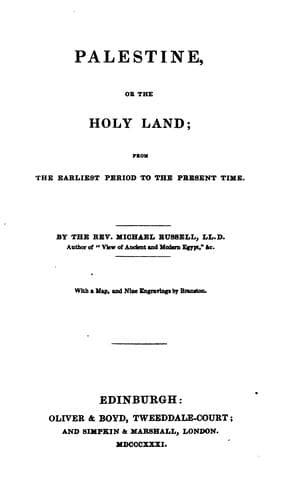
Palestine, or, the Holy Land: From the Earliest Period to the Present TimeRussell, Michael
History
Palestine, or, the Holy Land: From the Earliest Period to the Present Time
Russell, Michael
Palestine -- Description and travel; Palestine -- History
From the exode, in short, till towards the end of Joshua's administration,
we lose sight of that simple scheme of domestic superintendence which
Jacob established among his sons. The princes of tribes, and the heads of
families, were converted into captains of thousands, of hundreds, and of
fifties; regulating their movements by the sound of the trumpet, and
passing their days of rest amid the vigilance and formality of a regular
encampment. But no sooner did they convert the sword into a ploughshare,
and the spear into a pruning-hook, than they unanimously returned to their
more ancient form of society. As soon as there appeared a sufficient
quantity of land wrested from the Canaanites to afford to the tribes on
the western side of the Jordan a competent inheritance, Joshua "sent the
people away, and they departed;" and from this moment the military aspect
that their community had assumed gave way to the patriarchal model, to
which in fact all their institutions bore an immediate reference, and to
the restoration of which their strongest hopes and wishes were constantly
directed.
Actuated by such views, it cannot be denied that the Hebrews manifested
an undue impatience to enjoy the fruits of their successful invasion.
They had fought, it should seem, to obtain an inheritance in a rich and
pleasant country, rather than to avenge the cause of pure religion, or
to punish the idolatrous practices of the children of Moab and Ammon. As
soon, therefore, as the fear of their name and the power of their arms
had scattered the inhabitants of the open countries, the Israelites
began to sow and to plant; being more willing to make a covenant with
the residue of the enemy, than to purchase the blessings of a permanent
peace by enduring a little longer the fatigue and privations of war.
Their eagerness to get possession of the land flowing with milk and
honey seems to have compelled Joshua to adopt a measure, which led at no
distant period to much guilt and suffering on the part of his people. He
consented that they should occupy the vacant fields before the nations
which they had been commissioned to displace were finally subdued; that
that they should cast lots for provinces which were still in the hands
of the native Gentiles; and that they should distribute, by the line and
the measuring-rod, many extensive hills and fair valleys which had not
yet submitted to the dominion of their swords.
Public-domain text, read in full here on John Shaqi.
Reviews
Reviews
No reviews yet
Be the first to share your thoughts on this work.
Join the Discussion
Join the discussion
Sign in to leave a comment or review.
Sign InorCreate an account