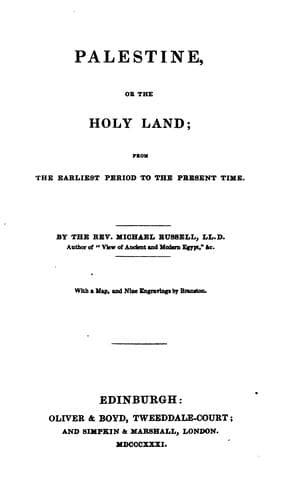
Palestine, or, the Holy Land: From the Earliest Period to the Present TimeRussell, Michael
History
Palestine, or, the Holy Land: From the Earliest Period to the Present Time
Russell, Michael
Palestine -- Description and travel; Palestine -- History
The effects of this injudicious policy soon rendered themselves apparent;
and all the evils which were foreseen by the aged servant of God, when he
addressed the congregation at Shechem, were realized in a little time to
their fullest extent. The Hebrews did indeed find the remnant of the
nations among whom they consented to dwell proving scourges in their
sides and thorns in their eyes, and still able to dispute with them the
possession of the good land which they had been taught to regard as a
sacred inheritance conferred upon them in virtue of a divine promise made
to their fathers. For example, the author of the book of Judges relates,
"the Amorites forced the children of Dan into the mountains;" for, he
adds, "they would not suffer them to come down to the valley." Hence arose
the fact, that the Israelites did not for several hundred years complete
their conquest of Palestine. The Canaanites, recovering from the terror
which had fallen upon them in the commencement of the Hebrew invasion,
attempted, not only to regain possession of their ancient territory,
but even to obliterate all traces of their defeat and subjection. What
movements were made by the petty sovereigns of the country, in order to
effect their object, we are nowhere expressly told; but we find, from a
consultation held by the southern tribes of Israel, soon after the death
of Joshua, that the necessity of renewing military operations against the
natives could no longer be postponed. It was resolved, accordingly, that
Judah and Simeon should unite their arms, and take the field, to prevent,
in the first place, an inroad with which their borders were threatened,
and, subsequently, to reduce to a state of entire subjection the cities
and towns that stood within the limits of their respective districts. "And
Judah said unto Simeon his brother, come up with me into my lot, that we
may fight against the Canaanites; and I likewise will go with thee into
thy lot."[11]
But, leaving these preliminary matters, we shall proceed to take a survey
of the Hebrew commonwealth, as it appeared upon its first settlement under
the successors of Joshua; endeavouring to ascertain the grounds upon which
the federal union of the tribes was established; their relations towards
one another in peace and in war; the resources of which they were
possessed for conquest or self-defence; their civil rights and privileges
as independent states; their laws and judicatories; and, above all, the
nature and extent of their property, as well as the tenure on which it
was held by families and individuals. Closely connected with this subject
is a consideration of that agrarian law which was sanctioned by Moses
and acted upon by Joshua, and which will be found, not only to have
determined, but also to have secured, the inheritance of every Israelite
who entered the Promised Land.
Public-domain text, read in full here on John Shaqi.
Reviews
Reviews
No reviews yet
Be the first to share your thoughts on this work.
Join the Discussion
Join the discussion
Sign in to leave a comment or review.
Sign InorCreate an account