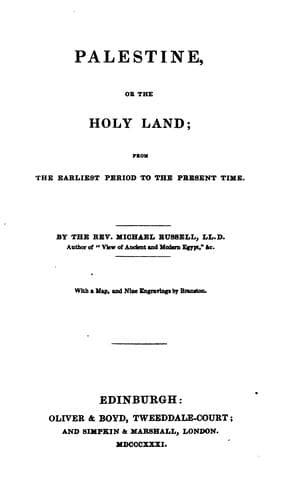
Palestine, or, the Holy Land: From the Earliest Period to the Present Time — John Shaqi
Palestine, or, the Holy Land: From the Earliest Period to the Present TimeRussell, Michael
History
Palestine, or, the Holy Land: From the Earliest Period to the Present Time
Russell, Michael
Palestine -- Description and travel; Palestine -- History
The extent of that portion of Syria which was granted to the Hebrew nation
has been variously estimated. On the authority of Hecataeus, a native
of Abdera, who is quoted by Josephus, the limits of the territory
possessed by the Jews are fixed at three millions of acres, supposing
the _aroura_ of the Greeks to correspond to the denomination of English
measure just specified. Proceeding on this ground, the Abbé Fleury and
other writers have undertaken to prove that the quantity of land mentioned
by Hecataeus would maintain only three millions three hundred and
seventy-five thousand men,--a computation which is liable to many
objections, and has not therefore been generally received. It is obvious,
for instance, that the Abderite, who lived in the reign of Alexander the
Great, and is said to have afterward attached himself to the person of the
first Grecian king of Egypt, described the country of the Jews as he saw
it, under the dominion of the Syrian princes of the Macedonian line. He
accordingly beheld only the inheritance of the two tribes which had
returned from the Babylonian captivity, and of consequence confined his
estimates to the provinces that they were permitted to enjoy; taking no
account of those extensive districts that formerly belonged to the Ten
Tribes of Israel, and which, in his days, were in the hands of that mixed
race of men who were descended from the Assyrian colonists whom
Shalmaneser placed in their room.[12]
Confiding in the greater accuracy of Spanheim, Reland, and Lowman, we are
inclined to compute the Hebrew territory at about fifteen millions of
acres; assuming, with these writers, that the true boundaries of the
Promised Land were, Mount Libanus on the north, the Wilderness of Arabia
on the south, and the Syrian Desert on the east. On the west some of the
tribes extended their possessions to the very waters of the Great Sea,
though on other parts they found their boundary restricted by the lands of
the Philistines, whose rich domains comprehended the low lands and strong
cities which stretched along the shore. It has been calculated by
Spanheim, that the remotest points of the Holy Land, as possessed by King
David, were situated at the distance of three degrees of latitude, and as
many degrees of longitude, including in all about twenty-six thousand
square miles.[13]
Public-domain text, read in full here on John Shaqi.
Reviews
Reviews
No reviews yet
Be the first to share your thoughts on this work.
Join the Discussion
Join the discussion
Sign in to leave a comment or review.
Sign InorCreate an account