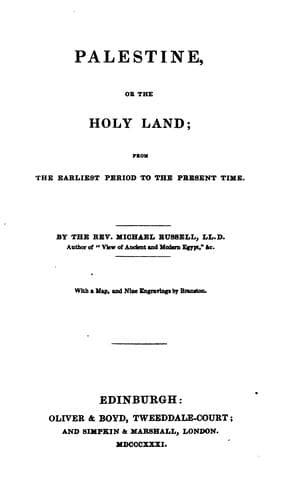
Palestine, or, the Holy Land: From the Earliest Period to the Present Time — John Shaqi
Palestine, or, the Holy Land: From the Earliest Period to the Present TimeRussell, Michael
History
Palestine, or, the Holy Land: From the Earliest Period to the Present Time
Russell, Michael
Palestine -- Description and travel; Palestine -- History
If this computation be correct, there was in the possession of the Hebrew
chiefs land sufficient to allow to every Israelite capable of bearing arms
a lot of about twenty acres; reserving for public uses, as also for the
cities of the Levites, about one-tenth of the whole. It is probable,
however, that if we make a suitable allowance for lakes, mountains, and
unproductive tracts of ground, the portion to every householder would not
be so large as the estimate now stated. But within the limits of one-half
of this quantity of land there were ample means for plenty and frugal
enjoyment. The Roman people under Romulus and long after could afford only
two acres to every legionary soldier; and in the most flourishing days of
the commonwealth the allowance did not exceed four. Hence the _quatuor
jugera_, or four acres, is an expression which proverbially indicated
plebeian affluence and contentment,--a full remuneration for the toils of
war, and a sufficient inducement at all times to take up arms in defence
of the republic.
The territory of the Hebrews was ordered to be equally divided among their
tribes and families according to their respective numbers; and the persons
selected to superintend this national work were Eleazar, the high-priest,
Joshua, who acted in the character of judge, and the twelve princes or
heads of Israel. The rule which they followed is expressed in these
words,--"And ye shall divide the land by lot, for an inheritance among
your families; and to the more ye shall give the more inheritance; and to
the fewer ye shall give the less inheritance: every man's inheritance
shall be in the place where his lot falleth; according to the tribes of
your fathers ye shall inherit."
Every tribe was thus put in possession of a separate district or province,
in which all the occupiers of the land were not only Israelites, but
more particularly sprung from the same stock, and descendants of the
same patriarch. The several families, again, were placed in the same
neighbourhood, receiving their inheritance in the same part or subdivision
of the tribe; or, to use the language of Lowman, each tribe may be said to
have lived together in one and the same country, and each family in one
and the same hundred; so that every neighbourhood were relations to each
other and of the same families, as well as inhabitants of the same place.
Public-domain text, read in full here on John Shaqi.
Reviews
Reviews
No reviews yet
Be the first to share your thoughts on this work.
Join the Discussion
Join the discussion
Sign in to leave a comment or review.
Sign InorCreate an account