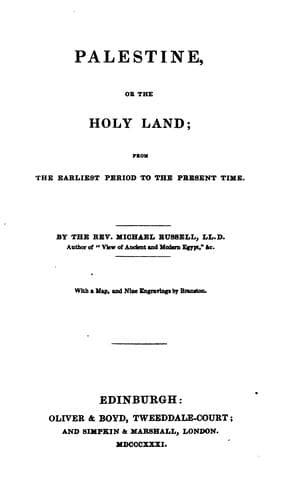
Palestine, or, the Holy Land: From the Earliest Period to the Present Time — John Shaqi
Palestine, or, the Holy Land: From the Earliest Period to the Present TimeRussell, Michael
History
Palestine, or, the Holy Land: From the Earliest Period to the Present Time
Russell, Michael
Palestine -- Description and travel; Palestine -- History
To secure the permanence and independence of every separate tribe, a law
was enacted by the authority of Heaven, providing that the landed property
of every Israelite should be unalienable. Whatever encumbrances might
befall the owner of a field, and whatever might be the obligations under
which he placed himself to his creditor, he was released from all claims
at the year of jubilee. "Ye shall hallow," said the inspired legislator,
"the fiftieth year, and proclaim liberty throughout all the land unto all
the inhabitants thereof. It shall be a jubilee unto you, and ye shall
return every man to his possession, and ye shall return every man unto his
family. And the land shall not be sold for ever; for the land is mine,
saith the Lord; for ye are strangers and sojourners with me."[14]
The attentive reader of the Mosaical law will observe, that though a
Hebrew could not divest himself of his land in perpetuity, he could
dispose of it so far as to put another person in possession of it during a
certain number of years; reserving to himself and his relations the right
of redeeming it, should they ever possess the means; and having at all
events the sure prospect of a reversion at the period of the jubilee. In
the eye of the lawgiver this transaction was not regarded as a sale of the
land, but merely of the crops for a stated number of seasons. It might
indeed have been considered simply as a lease, had not the owner, as well
as his nearest kinsman, enjoyed the privilege of resuming occupation
whenever they could repay the sum for which the temporary use of the land
had been purchased.[15]
The houses which were built in fields or villages were, in regard to
the principle of alienation, placed on the same footing as the lands
themselves; being redeemable at all times, and destined to return to their
original owners in the year of jubilee. But, on the contrary, houses in
cities and large towns were, when sold, redeemable only during one year;
after which the sale was held binding forever. There was indeed an
exception in this case in favour of the Levites, who could at any time
redeem "the houses of the cities of their possession," and who, moreover,
enjoyed the full advantage of the fiftieth year.
Public-domain text, read in full here on John Shaqi.
Reviews
Reviews
No reviews yet
Be the first to share your thoughts on this work.
Join the Discussion
Join the discussion
Sign in to leave a comment or review.
Sign InorCreate an account