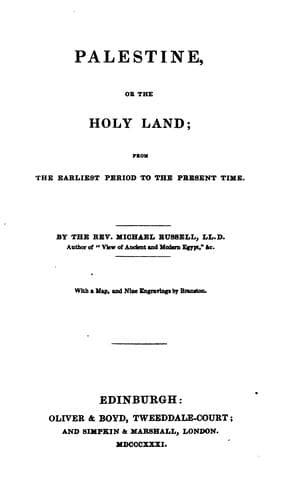
Palestine, or, the Holy Land: From the Earliest Period to the Present TimeRussell, Michael
History
Palestine, or, the Holy Land: From the Earliest Period to the Present Time
Russell, Michael
Palestine -- Description and travel; Palestine -- History
This catalogue comprehended all the men above twenty years of age, to
which may be added 23,000 of the tribe of Levi, "all males from a month
old and upward: for they were not numbered among the children of Israel,
because there was no inheritance given them among the children of Israel."
The whole amounted to six hundred and six thousand seven hundred.[17]
In every tribe there was a chief called the Prince of the Tribe, or
the Head of Thousands; and under him were the Princes of Families, or
Commanders of Hundreds. For example, we find that at the muster which
was made of the Hebrews in the Wilderness of Sinai, Nahshon, the son of
Amminadab, was Prince of the Tribe of Judah. This tribe, again, like all
the others, was divided into several families; the term being used here
not in its ordinary acceptation, to signify a mere household, but rather
in the heraldic sense, to denote a lineage or kindred descended from a
common ancestor, and constituting the main branches of an original stock.
In this respect the Israelites were guided by the same principle which
regulates precedency among the Arabs, as well as among our own countrymen
in the Highlands of Scotland.
It appears, moreover, that a record of these families, of the households
in each, and even of the individuals belonging to every household,
was placed in the hands of the chief ruler; for it is related that,
on the suspicion excited with regard to the spoils of Jericho and the
discomfiture at Ai, "Joshua brought Israel by their tribes, and the tribe
of Judah was taken; and he brought the family of Judah, and he took the
family of the Zarhites; and he brought the family of the Zarhites man by
man, and Zabdi was taken; and he brought his household man by man, and
Achan, the son of Carmi, the son of Zabdi, the son of Zerah, of the tribe
of Judah, was taken."[18]
We may collect from the twenty-sixth chapter of the book of Numbers, that
the Heads of Families, at the time the children of Israel encamped on the
eastern bank of the Jordan, were in number fifty-seven. If to these we add
the thirteen Princes, the Heads of tribes, the sum of the two numbers will
be seventy; whence there is some ground for the conjectures of those who
allege, that the council which Moses formed in the Wilderness consisted of
the patriarchal chiefs, who in right of birth were recognized as bearing
an hereditary rule over the several sections of the people.
Public-domain text, read in full here on John Shaqi.
Reviews
Reviews
No reviews yet
Be the first to share your thoughts on this work.
Join the Discussion
Join the discussion
Sign in to leave a comment or review.
Sign InorCreate an account