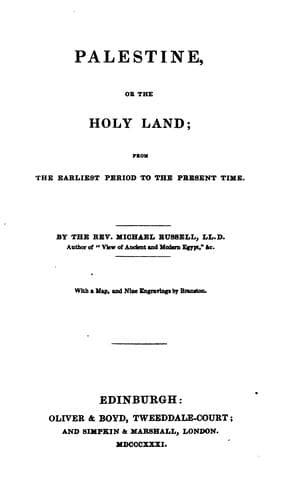
Palestine, or, the Holy Land: From the Earliest Period to the Present TimeRussell, Michael
History
Palestine, or, the Holy Land: From the Earliest Period to the Present Time
Russell, Michael
Palestine -- Description and travel; Palestine -- History
It is probable that the first-born of the senior family of each tribe
was usually received as the prince of that tribe, and that the eldest
son of every subordinate family succeeded his father in the honours and
duties which belonged to the rank of a patriarch. But the sacred narrative
presents too few details to permit us to form with confidence any general
conclusions in regard to this point. The case of Nahshon, besides, has
been viewed as an instance quite irreconcilable with such an opinion;
and it certainly seems to prove, that if the Prince of the Tribe was
not elective, he was not always, at least, the direct descendant of
the original chief. Nahshon, as has just been stated, was the son of
Amminadab, the son of Ram, who was a younger son of Hezron the son of
Pharez who was a younger son of Judah.[19]
From the particulars now stated, we find that every tribe had a head who
presided over its affairs, administered justice in all ordinary cases, and
led the troops in time of war. He was assisted in these important duties
by the subordinate officers, the Chiefs of Families, who formed his
council in such matters of policy as affected their particular district,
supported his decisions in civil or criminal inquiries, and finally
commanded under him in the field of battle.
But the polity established by the Jewish lawgiver was not confined to
the constitution and government of the separate tribes. It likewise
extended its regulations to the common welfare of the whole, as one
kingdom under the special direction of Jehovah; and provided that on
all great occasions they should have the means of readily uniting their
counsels and their strength. Even during the less orderly period which
immediately followed the settlement of the Hebrews in the land of their
inheritance, we find traces of such a general government; a national
senate, whose deliberations guided the administration of affairs in all
cases of difficulty or hazard; a judge, who was invested with a high
degree of executive authority as the first magistrate of the commonwealth;
and lastly, the controlling voice of the congregation of Israel, whose
concurrence appears to have been at all times necessary to give vigour and
effect to the resolutions of their leaders. To these constituent parts of
the Hebrew government we may add the Oracle or voice of Jehovah, without
whose sanction, as revealed by Urim and Thummim, no measure of importance
could be adopted either by the council or by the judge.
Public-domain text, read in full here on John Shaqi.
Reviews
Reviews
No reviews yet
Be the first to share your thoughts on this work.
Join the Discussion
Join the discussion
Sign in to leave a comment or review.
Sign InorCreate an account