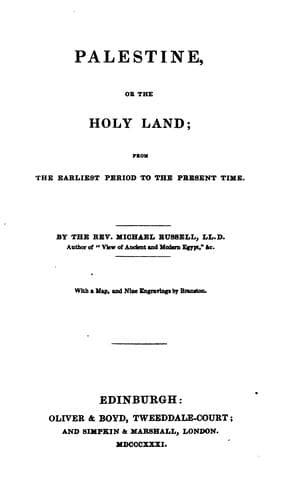
Palestine, or, the Holy Land: From the Earliest Period to the Present TimeRussell, Michael
History
Palestine, or, the Holy Land: From the Earliest Period to the Present Time
Russell, Michael
Palestine -- Description and travel; Palestine -- History
With the aid of the particulars stated above, the reader mad have been
enabled to form some notion of the civil and political circumstances of
the ancient Hebrews. They enjoyed the utmost degree of freedom that was
consistent with the objects of regular society, acknowledging no
authority but that of the laws as administered by the elders of their
tribes and the heads of their families. The equality of their property,
too, and the sameness of their occupations, precluded the rise of those
distinctions in social life which, whatever may be their use in older
nations, are opposed by all the habits of a people whose sole cares are
yet devoted to the culture of their fields and the safety of their
flocks. The form of government which suits best with such a distribution
of wealth and employment is unquestionably that which was established by
Moses on the basis of the ancient patriarchal rule. But it is worthy of
notice, that this model, so convenient in the earliest stage of social
existence, was imperceptibly changed by the increasing power and
intelligence of the people at large, until, as happened towards the
close of Samuel's administration, the public voice made itself be heard
recommending an entire departure from obsolete notions. They glorified
in the progress of the human race, that the simple authority of the
family-chief passes through a species of oligarchy into a practical
democracy, and ends at no very distant period in the nomination of an
hereditary sovereign.
The epoch at which we now contemplate the Hebrew community is that very
interesting one when the wandering shepherd settles down into the
stationary husbandman. The progeny of Abraham, Isaac, and Jacob, who
themselves were pastoral chiefs, appear to have retained a decided
predilection for that ancient mode of life. Moses, even after he had
brought the twelve tribes within sight of the promised land, found it
necessary to indulge the families of Reuben, Gad, and Manasseh so far as
to give them the choice of a settlement beyond the Jordan, where they
might devote themselves to the keeping of cattle. From the conduct also
of the other tribes, who showed no small reluctance to divide the land
and enter upon their several inheritances, it has been concluded, with
considerable probability, that they too would have preferred the erratic
habits of their ancestors to the more restricted pursuits which their
great law-giver had prepared for them amid cornfields, vineyards, and
plantations of olives. "And Joshua said unto the children of Israel, How
long are ye slack to go to possess the land which the Lord God of your
fathers hath given you?"[27]
Public-domain text, read in full here on John Shaqi.
Reviews
Reviews
No reviews yet
Be the first to share your thoughts on this work.
Join the Discussion
Join the discussion
Sign in to leave a comment or review.
Sign InorCreate an account