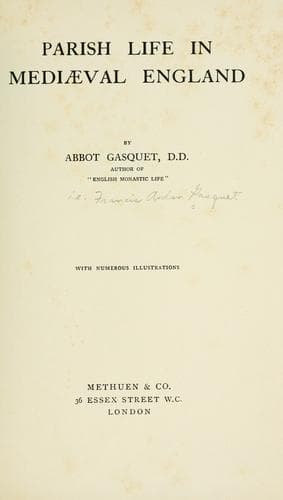
Parish life in mediæval EnglandGasquet, Francis Aidan
History
Parish life in mediæval England
Gasquet, Francis Aidan
England -- Church history -- 1066-1485; England -- Social life and customs -- 1066-1485
_Tithes_ are commonly defined as “the tenth part of all fruits and
profits justly acquired, owed to God in recognition of His supreme
dominion over man, and to be paid to the ministers of the Church.” In
the Old Dispensation this recognition was made by Abraham, promised
under vow by Jacob, and legally regulated by Moses. In early Christian
times, if there is no evidence of the existence of the practice, it
is only because the voluntary offerings of the faithful were ample to
supply the needs of the Church and its ministers, whilst the community
of goods practised by the first Christians hardly allowed the existence
of real poverty among them. As the Church grew, its needs, and in
particular the less obvious needs of the faithful poor, required some
more regular and certain resources than the irregular and voluntary
alms of its richer members. So in the Council of Macon in A.D. 585 is
found the first express declaration of the Christian obligation of
paying tithes, not indeed as a new law, but as the assertion of an
admitted Christian principle. In the eighth century these payments
began to be regularly made throughout the Western Church, and in
England, according to the Saxon Chronicle, in A.D. 855 the father of
King Alfred, Ethelwulf of Wessex, is said to have “assigned to the
Church the tenth part of his land all over his kingdom for the love
of God and his own everlasting weal.” In this it is almost certain
that the Chronicle is wrong in the form of expression, and that what
Ethelwulf did was to decree the payment of a tithe of the produce,
and not hand over a tenth of the land as an endowment of the Church.
And here it may be well to remark that there was obviously nothing
sacro-sanct about the tenth portion payable for Church purposes. It is
merely a portion that is taken to represent what is generally a fair
offering to God, and one not too burdensome on those who had to pay. In
some cases it might be and indeed, according to custom, was greater or
less in different places.
Tithes were usually divided into two kinds--_predial_ and _personal_;
“some coming of the earth,” says the author of _Dives and Pauper_,
“as corn, wine, bestayle, that is brought forth by the land, and such
thyngs be clepyd _predyales_ in latyn. Some thyngs comyth oonly of
the person, as be merchandy and werkmanschyp, and such bene clepyd
_personales_ in latyn.” In these a man is to account his expenses, and
then see whether he has gained, and so pay a tithe of his profit; but
this may not be done in the case of the predial tithes. In these “he is
not to count his expenses, but pay his tithe of all, neither the worst
nor the best, but as it comes.”
Public-domain text, read in full here on John Shaqi.
Reviews
Reviews
No reviews yet
Be the first to share your thoughts on this work.
Join the Discussion
Join the discussion
Sign in to leave a comment or review.
Sign InorCreate an account