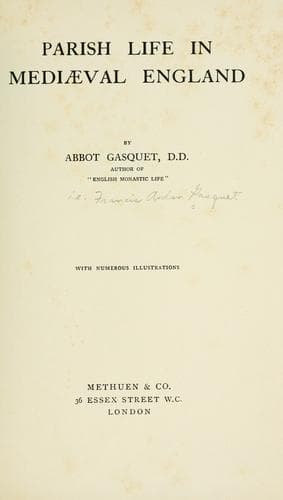
Parish life in mediæval EnglandGasquet, Francis Aidan
History
Parish life in mediæval England
Gasquet, Francis Aidan
England -- Church history -- 1066-1485; England -- Social life and customs -- 1066-1485
That this settlement was not at all exceptional could be proved by many
documents; one must suffice. When Bodmin church was rebuilt between the
years 1469 and 1472 the patrons, the Monastery of St. Petrock, defrayed
the entire expenses connected with the chancel. On the other hand, to
illustrate the usual practice, the case of the vicarage of Launcells in
Devonshire may be cited. The Abbot and Monastery of Hartland held the
appropriated tithes, and in 1382, the chancel standing in need of great
repairs, apparently amounting almost to rebuilding, the vicar refused
to carry out the injunctions of the archdeacon forthwith to undertake
the work, on the plea that this was the duty of the Abbey of Hartland.
The convent denied their obligation, but submitted themselves in the
matter to the judgment of the bishop of the diocese. After holding an
inquiry, Bishop Thomas Brantyngham declared that the vicar received
tithes for the purpose of carrying out all repairs to the chancel, and
that consequently the monks were free from the obligation.
What the material church was to the parishioners of a mediæval parish
is well described in the synodical Constitutions of Bishop Woodlock, of
Winchester, at the beginning of the fourteenth century.
“If the Israelites,” he says, “living in the shadow of the law,
required specially dedicated places in which to worship the Lord, with
how much more reason are Christians, to whom the loving-kindness and
the humanity of the Saviour has appeared, bound by all the means at
their disposal to obtain consecrated churches, in which day by day the
Son of God is offered in Sacrifice.”
Then after saying that churches that have not been consecrated are to
be solemnly dedicated as soon as possible, he continues--
“The anniversaries of the dedications of parish churches are to
be kept by the parishioners, and those attending chapels in the
neighbourhood not themselves dedicated. The day and the year of the
consecration, with the name of the consecrating prelates, are to be
entered in the calendar and other books belonging to the church.”
The dedication of the church to God was the essential condition of its
endowment. According to Bracton, the dower made to the church with
church lands at its dedication, was a possession of “pure and free
alms,” in distinction “from a lay feud,” seeing that it “is with more
propriety called free, since it is dedicated as it were to God.”
“If,” says the Constitution of Cardinal Otho for the English
Church--“if under the Old Testament the Temple was dedicated to God
for the offering of dead animals, with how much more reason should the
churches of the New Law be specially consecrated to Him when on the
altars is daily offered for us by the hands of the priest the living
and true Victim, that is, Christ, the only-begotten Son of God.”
Public-domain text, read in full here on John Shaqi.
Reviews
Reviews
No reviews yet
Be the first to share your thoughts on this work.
Join the Discussion
Join the discussion
Sign in to leave a comment or review.
Sign InorCreate an account