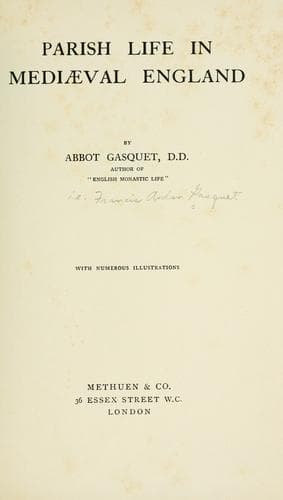
Parish life in mediæval EnglandGasquet, Francis Aidan
History
Parish life in mediæval England
Gasquet, Francis Aidan
England -- Church history -- 1066-1485; England -- Social life and customs -- 1066-1485
The reverence due to churches, and things once dedicated to the service
of churches, was universal in the Middle Ages. Cloths, used as chrism
cloths at Baptism or Confirmation, were to be devoted to ecclesiastical
purposes or destroyed, and those who turned anything thus once offered
to God to any secular use were considered gravely blameworthy. The
gloss upon a Constitution of St. Edmund of Canterbury to this effect
extends this prohibition of desecration to everything connected at any
time with a church. Even the woodwork of a building, once dedicated,
was to be destroyed, unless it was capable of being used for another
ecclesiastical purpose. So too the “cloths used on the altar, the
seats, candlesticks, veils, and sacred vestments too old to use,” were
to be burnt and the ashes buried.
The parishioners, as already pointed out, were bound by law and custom
to provide for the repair of the nave of their parish church, and for
the general upkeep of the church services. There was little need to
compel them to fulfil this duty, for the churchwardens’ accounts and
other documents, especially during the fifteenth century, when we
have the fullest information, show us that over the entire length and
breadth of England the people were gladly rebuilding and beautifying
their parish churches. A few examples of this spirit may be of interest
as showing what God’s house was to the entire people in pre-Reformation
days. The labours of Prebendary Hingeston-Randolph on the diocesan
registers of the Exeter diocese enable the inquirer into parochial
manners and customs of the past to find ample material. In the register
of Bishop Stafford of Exeter (1394-1419) an account of the rebuilding
of the parish church of Broadhempston is given. The parishioners, about
A.D. 1400, petitioned the bishop to be allowed to rebuild their church:
they represented that it was in a ruinous condition and notoriously
clumsily constructed. It was their wish, they said, to build it on a
larger scale, and in a different part of the churchyard. To this the
bishop assented, on condition of their promising to complete the new
church within two years of pulling down the old, and he granted an
Indulgence to all who should contribute to “so great and pious a work.”
On the 22nd November, 1401, the work of the new church was apparently
far enough advanced for use, for a licence was granted for one year to
celebrate Divine service “in the church or basilica newly erected and
constructed in the cemetery,” and this licence was twice renewed for
the years 1402 and 1403.
Public-domain text, read in full here on John Shaqi.
Reviews
Reviews
No reviews yet
Be the first to share your thoughts on this work.
Join the Discussion
Join the discussion
Sign in to leave a comment or review.
Sign InorCreate an account