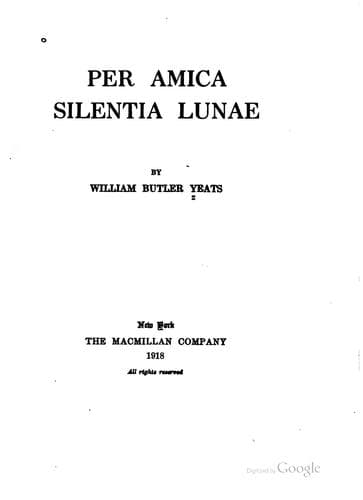
Per Amica Silentia LunaeYeats, W. B. (William Butler)
Philosophy
Per Amica Silentia Lunae
Yeats, W. B. (William Butler)
Essays
I have always sought to bring my mind close to the mind of Indian and
Japanese poets, old women in Connaught, mediums in Soho, lay brothers whom
I imagine dreaming in some mediaeval monastery the dreams of their
village, learned authors who refer all to antiquity; to immerse it in the
general mind where that mind is scarce separable from what we have begun
to call "the subconscious"; to liberate it from all that comes of councils
and committees, from the world as it is seen from universities or from
populous towns; and that I might so believe I have murmured evocations and
frequented mediums, delighted in all that displayed great problems
through sensuous images, or exciting phrases, accepting from abstract
schools but a few technical words that are so old they seem but broken
architraves fallen amid bramble and grass, and have put myself to school
where all things are seen: _A Tenedo Tacitae per Amica Silentia Lunae_. At
one time I thought to prove my conclusions by quoting from diaries where I
have recorded certain strange events the moment they happened, but now I
have changed my mind--I will but say like the Arab boy that became Vizier:
"O brother, I have taken stock in the desert sand and of the sayings of
antiquity."
II
There is a letter of Goethe's, though I cannot remember where, that
explains evocation, though he was but thinking of literature. He described
some friend who had complained of literary sterility as too intelligent.
One must allow the images to form with all their associations before one
criticises. "If one is critical too soon," he wrote, "they will not form
at all." If you suspend the critical faculty, I have discovered, either as
the result of training, or, if you have the gift, by passing into a slight
trance, images pass rapidly before you. If you can suspend also desire,
and let them form at their own will, your absorption becomes more complete
and they are more clear in colour, more precise in articulation, and you
and they begin to move in the midst of what seems a powerful light. But
the images pass before you linked by certain associations, and indeed in
the first instance you have called them up by their association with
traditional forms and sounds. You have discovered how, if you can but
suspend will and intellect, to bring up from the "subconscious" anything
you already possess a fragment of. Those who follow the old rule keep
their bodies still and their minds awake and clear, dreading especially
any confusion between the images of the mind and the objects of sense;
they seek to become, as it were, polished mirrors.
Public-domain text, read in full here on John Shaqi.
Reviews
Reviews
No reviews yet
Be the first to share your thoughts on this work.
Join the Discussion
Join the discussion
Sign in to leave a comment or review.
Sign InorCreate an account