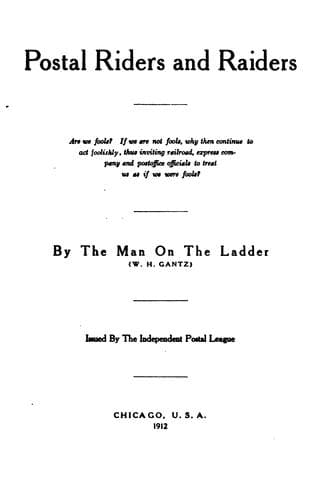
Postal service -- United States -- Second-class matter
When Frank H. Hitchcock, after being chairman of the Republican
National Committee in the campaign of 1908, was made Postmaster
General as a reward for his political services, he inherited,
in his department, a deficit, an antiquated, cumbersome and
unbusinesslike organization, and several sets of figures.
_Hitchcock is young and ambitious._ He has been in the government
service, in various capacities, most of his life since leaving
college. He was anxious to make a record. As Postmaster General
_he was political paymaster_ for the administration, to a great
degree, as there are more postmasters than any one other kind
of public officials, and postmasterships are perquisites of the
faithful politicians in the Senate and House of Representatives.
This kept Hitchcock in politics, in a way, for he knew what the
obligations of the administration were, having made most of them
as national chairman, and he paid them off as circumstances
permitted.
He thought, too, that if he could put the Postoffice Department
on a self-sustaining basis--where it had not been for years,
if ever--he would do a great stroke for himself; and he began
work along those lines. There need be no discussion here of the
methods by which he made apparent reductions in the expenses of
the department. Whether by bookkeeping or otherwise, he did make
some apparent reductions, mostly by not spending appropriated
moneys, by reductions in force, by elimination of substitute
carriers and by other similar means.
Mr. Hitchcock, it would seem, was a peculiarly active public servant. Mr.
Blythe also speaks of how Mr. Hitchcock got a cue from a predecessor,
Charles Emory Smith. Mr. Smith in the _industrious activities of his
official duties_, signing of reports which subordinates wrote, vouchers
for contracts and other payments, and drawing his salary--Mr. Smith had
laboriously (?) figured it out that the second-class mail rate ought
to be 7 cents a pound. Mr. Hitchcock goes Smith two cents better. This
statement of Mr Smith’s grew on Mr. Hitchcock. “It opened the way to two
things,” as Mr. Blythe ably points out as follows:--
First he could increase the revenue of the department if he could
increase the second-class rate; and second, he could get a whip
hand over the magazine press.
He reported his assumed facts to the President in time for Mr.
Taft’s message to Congress, sent in in December, 1909. In that
message Mr. Taft made the statement that it costs the government
9 cents a pound to transport second-class mail matter, the total
cost being more than sixty million dollars a year, and asked
that there should be an increase in second-class rates. Mr. Taft
instanced this as a subsidy for the magazine and periodical
press. Mr. Hitchcock’s report as Postmaster General contained
substantially the same statements.
Public-domain text, read in full here on John Shaqi.
Reviews
Reviews
No reviews yet
Be the first to share your thoughts on this work.
Join the Discussion
Join the discussion
Sign in to leave a comment or review.
Sign InorCreate an account