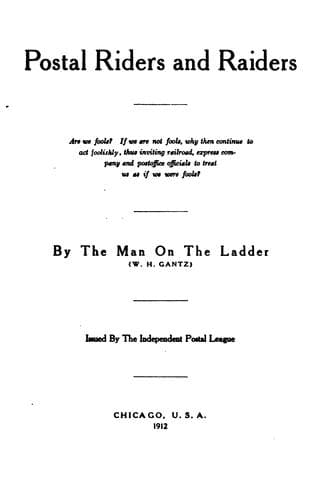
Postal service -- United States -- Second-class matter
(Page 21.)
7 “Provided,
8 That out of the appropriation for inland mail transportation
9 the Postmaster General is authorized hereafter to
10 pay rental if necessary in Washington, District of Columbia,
11 and compensation to tabulators and clerks employed in connection
12 with the weighings for assistance in completing computations,
13 in connection with the expenses of taking the
14 weights of mails on railroad routes, as provided by law:
15 And provided further, That during the fiscal year ending
16 June thirtieth, nineteen hundred and twelve, the rate of postage
17 on textual and general reading matter contained in periodical
18 publications other than newspapers, as described in the
19 Act of Congress approved March third, eighteen hundred
20 and seventy-nine, entitled “An Act making appropriations
21 for the service of the Postoffice Department for the fiscal
22 year ending June thirtieth, eighteen hundred and eighty,
23 and for other purposes,” and in the publications described
24 in an Act of Congress approved July sixteenth, eighteen
25 hundred and ninety-four, entitled “An Act making appropriations
(Page 22.)
1 for the service of the Postoffice Department for
2 the fiscal year ending June thirtieth, eighteen hundred and
3 ninety-five,” shall be one cent per pound, or fraction thereof;
4 and on _sheets_ of any _publication_ of either of said classes
5 containing, _in whole or part_, any advertisement, whether
6 display, descriptive, or textual, four cents per pound or
7 fraction thereof; Provided, That the increased rate shall not
8 apply to publications mailing less than four thousand pounds
9 of each issue.”
As previously stated, and pointed out by Senator Owen, all amendments of
character with the above are clearly in violation of Section 7, Article
1 of the Constitution of the United States. Here is the wording of that
section:
“All bills for raising revenue shall originate in the House of
Representatives; but the Senate may propose or concur with amendments as
on other bills.”
That is plain enough, is it not, as to the Senate’s lack of right or
power to _originate_ revenue-producing measures either by bill or
amendment? A glance at lines 4 to 9 (page 22), as above quoted, will
convince even a stranger in a strange town or a market garden delegate
that this “rider” amendment, if it had passed, would _originate revenue_.
Public-domain text, read in full here on John Shaqi.
Reviews
Reviews
No reviews yet
Be the first to share your thoughts on this work.
Join the Discussion
Join the discussion
Sign in to leave a comment or review.
Sign InorCreate an account