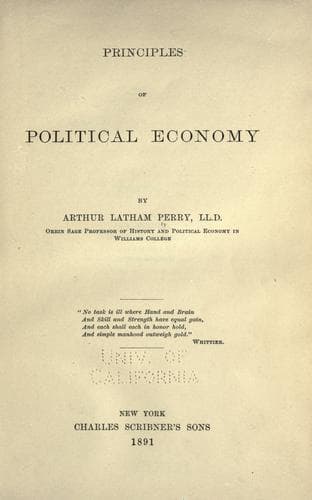
Principles of Political EconomyPerry, Arthur Latham
General
Principles of Political Economy
Perry, Arthur Latham
Economics
We are now in a good place to see once for all the sharp distinction
there is between Utility and Value. These two are often confounded to
the deep detriment of our Science; and no clear thinking is possible
in Economics without drawing this line sharp, and then holding it
fast; for the hazard of this confusion is all the greater, because
Utility is always connected with Value, although it is a totally
different thing from Value. We will see. Utility is the simple
capacity of anything to gratify the desire of anybody. This is at
once the etymological as well as the popular signification of the
word. It is derived from the Latin _utor_, to make use of, a word that
is often conjoined in Latin with _fruor_, to enjoy; so much so, that
the two verbs are often put together, _utor et fruor_, and also often
without the conjunctive, _utor fruor_. Utility, then, is a quality of
innumerable things. Anything that is _good for_ anything, anything
_useful_, anything that has the power to still _the desires_ of any
person, has Utility. But multitudes of things that have this capacity
to gratify human desires are never bought and sold, and therefore can
have no Value, since nobody will give anything for them. The air we
breathe, the water we refresh ourselves with from spring or brook, the
light of the sun and moon and stars, the fragrance of the flowers, the
mountain prospect that delights the eye,--all these, and thousands
more, possess the highest utility, but no value whatsoever. They are
free. They are the bounty of God. They are never bought and sold. They
are a vast class of things by themselves, with which Political Economy
as such has nothing to do.
Public-domain text, read in full here on John Shaqi.
Reviews
Reviews
No reviews yet
Be the first to share your thoughts on this work.
Join the Discussion
Join the discussion
Sign in to leave a comment or review.
Sign InorCreate an account