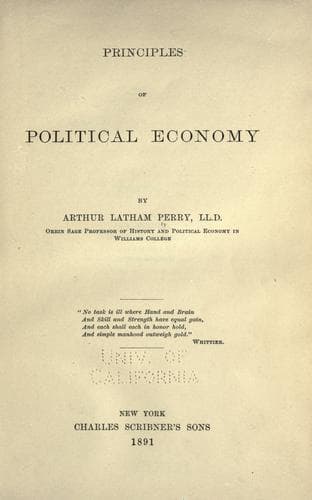
Principles of Political EconomyPerry, Arthur Latham
General
Principles of Political Economy
Perry, Arthur Latham
Economics
Nevertheless the element of Utility comes into every case of Value,
because the element of Desire comes into every case of Value, and
whatever merely satisfies the Desire of any person is Utility, whether
that capacity be the direct gift of God or whether the Efforts of men
have been employed to bring it about. It is just here that we see the
precise function of our "two efforts" in each case of Value, in
distinction from mere Utility in all cases: much of utility is
absolutely free, no effort of men having been put forth to secure it,
for example, the fragrance of the wild rose; much more of utility is
the commingled bounty of Nature and the gratuitous effort of men, for
example, the fragrance of the domestic rose brought by the householder
himself into his own yard for the gratification of his own family;
while by much the most of utility is commingled free gift of God and
the compensated efforts of men, for example, the fragrance of the bank
of roses cultivated and cared for by the hired gardener. It is
important for our purposes to discriminate carefully the three kinds
of Utility: (1) what is wholly disconnected from the efforts of men,
and comes freely from the hand of God; (2) what is mingled with the
unpaid efforts of men, so that the satisfaction of the desire comes
partly from Nature and partly from unbought effort; and (3) the
compound utility that is partly free gift and partly the result of
compensated labor. The last is the only kind of Utility that stands in
any connection with Value.
And even this is very different from Value. Utility in all three of
its forms--now free, now onerous, now partly bought--is always a
quality of one thing by itself, going straight to the satisfaction of
some desire, and there an end. It is simplicity itself compared with
Value, which is always a resultant of several things, and is
specifically a relation of mutual purchase established between two
"renderings," each of which expresses the value of the other, in each
of which is embodied an "effort" made by each of the two "persons"
rendering, and each of which excites a "desire" and an "estimate"
before being passed over in ownership to another, and a "satisfaction"
afterwards.
Public-domain text, read in full here on John Shaqi.
Reviews
Reviews
No reviews yet
Be the first to share your thoughts on this work.
Join the Discussion
Join the discussion
Sign in to leave a comment or review.
Sign InorCreate an account