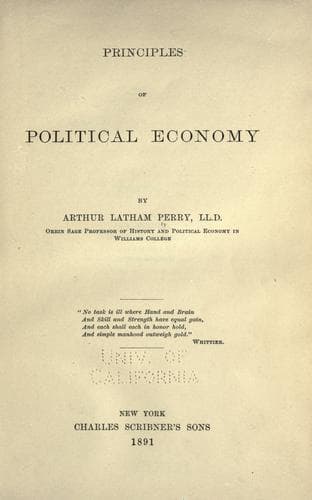
Principles of Political EconomyPerry, Arthur Latham
General
Principles of Political Economy
Perry, Arthur Latham
Economics
The utility in every valuable rendering comes partly from free Nature
and partly from compensated effort, but it is remarkable, that a
principle, with which we are to become very familiar later on, namely,
Competition, eliminates for the most part from all influence upon
Value that portion of the Utility that is the free gift of God. The
great Father never takes pay for anything, and never authorizes
anybody to take pay in his behalf; and, moreover, has arranged things
so, that it is exceedingly difficult for any person to extort anything
from another person on the strength of anything that God has made, and
man has not improved. Take, for example, ten horses of any general
grade, brought into the same market by their ten owners for sale.
These men did not make these horses, but they have cared for and
trained them, or at least have become proprietors by purchase or
otherwise of the results of such care and training. The Utility in
each horse is compound, consisting partly of what God has done for him
and partly of what man has done for him,--the two parts inextricably
interwoven,--and all ten are offered now for sale. Each of the owners
would indeed be glad to get something for his horse on the ground of
what God has done to make him sound and strong and fleet, in addition
to a fair compensation for what he (and his predecessors) has done in
raising and breaking him; but the cupidity of all is likely to be
thwarted by the ultimate willingness of some to sell their horses for
a price covering the element of human "efforts" involved, and the
action of these tends to fix a general rate for the whole ten, and
thus the gratuitous element is eliminated from influence on Value.
Even if the ten owners should combine for a higher price, there are
doubtless a plenty of horses of that general grade elsewhere, some of
whose owners are content to get back an equivalent for their own and
others' "efforts" expended on their horses; and so the action of these
tends to fix the general price for horses of that kind for that time
and place at a point not above a fair estimate of the onerous human
elements involved; thus throwing out by the action of competition all
effect of natural Utility upon the Value of horses then and there. So
of all other products of that kind.
It is true, that in certain unique cases, in which competition has
little or no play, because there is only one or a very few owners of
such unique products, one cannot certainly say that free Utility may
_not_ influence the Value to lift it above the gauge of human efforts
involved; but such cases are rare, and relatively unimportant; and the
tendency is immensely strong, under the natural and beneficial
condition of things, for Values to graduate themselves through the
reciprocal estimates and renderings of commerce, down to the actual
and onerous contribution of _men_ to that Utility that underlies
Value.
Public-domain text, read in full here on John Shaqi.
Reviews
Reviews
No reviews yet
Be the first to share your thoughts on this work.
Join the Discussion
Join the discussion
Sign in to leave a comment or review.
Sign InorCreate an account