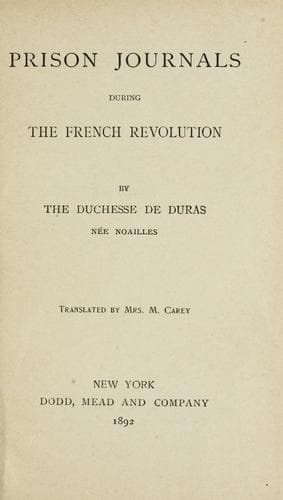
Prison Journals During the French RevolutionDuras, Louise Henriette Charlotte Philippine (de Noailles) de Durfort, duchesse de
History
Prison Journals During the French Revolution
Duras, Louise Henriette Charlotte Philippine (de Noailles) de Durfort, duchesse de
France -- History -- Revolution, 1789-1799 -- Personal narratives
The Revolutionary army succeeded the National Guard, and made its
entrance into the house in a manner suitable to the functions with
which it was charged. At ten o'clock in the evening we learned that
there were cannon pointed toward the château, and at the same moment we
heard the grating open amid songs which sounded more like rage than
joy. The van-guard was preceded by cannon, drums, and torches. Women
mingled with the procession. The refrain of 'Ça ira, les aristocrates à
la lanterne!' was repeated with stubborn animosity. My neighbours were
seized with terror, and rushed trembling into my apartment. I reassured
them as well as I could without knowing why, except that the feeling of
fear is one to which I do not readily yield.
When the troop had finished its dances and songs in the courtyard, and
gone through a sort of march, it placed its sentinels and retired. I
had the full benefit of the performance, as my windows opened on the
courtyard.
I cannot now remember the exact time, but a few days after the scene I
have just described took place, several prisoners were sent to the
prisons at Paris, among them Monsieur de Vernon, Master of Horse to the
king, who had gout in his hands, but on whom they put handcuffs. A
curate named Daniel was sent off with him. They were taken to the
prison of the Carmelites on the Rue de Vaugirard. A party of thirty
persons followed them immediately. Madame de Pontevès seeing them
carrying off her husband, asked a commissioner named Martin for
permission to go with him. He answered her roughly, granted her
request, and then separated them when they reached Paris. One of them
was put in the Madelonnettes, and the other in Ste. Pélagie. In order
to fill the prisons of Paris it was sometimes necessary to draw
recruits from the neighbouring prisons; for this purpose different
pretexts were made. Evil designs were imputed to the prisoners,--such
as anti-revolutionary projects; for instance, one was called an
agitator if he spoke to the keeper or to the commissioner in order to
make known his wants.
When any one came to inspect us I kept in the background. I was
obliged, however, to appear before Martin, the commissioner
extraordinary, who was accompanied by a man with a red cap, and had a
roll-call of all the prisoners. He only asked me my name. A sort of
officer who was with them said that he had dined once at the house of
Monsieur de Duras, at Bordeaux, and had been very well entertained. I
did not continue the conversation. Some of the prisoners pleaded their
causes, and petitioned to be allowed to go free. I withdrew as soon as
I possibly could.
Public-domain text, read in full here on John Shaqi.
Reviews
Reviews
No reviews yet
Be the first to share your thoughts on this work.
Join the Discussion
Join the discussion
Sign in to leave a comment or review.
Sign InorCreate an account