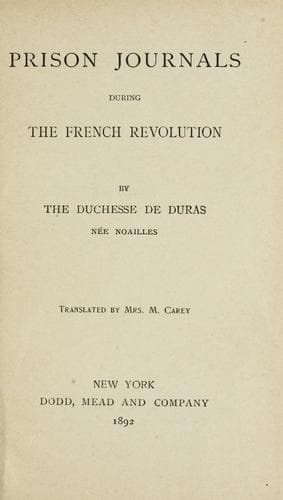
Prison Journals During the French Revolution — John Shaqi
Prison Journals During the French RevolutionDuras, Louise Henriette Charlotte Philippine (de Noailles) de Durfort, duchesse de
History
Prison Journals During the French Revolution
Duras, Louise Henriette Charlotte Philippine (de Noailles) de Durfort, duchesse de
France -- History -- Revolution, 1789-1799 -- Personal narratives
Monsieur de Saint-Souplet, the king's esquire, who was constantly
worrying about getting the news, was taken away, arraigned before the
Revolutionary tribunal, and perished on the scaffold with his father,
who was eighty years old, and one of his brothers. He was denounced by
one of his servants; but the latter was guillotined with him for not
having betrayed his master sooner. We now began to hear of a great many
executions; that of Madame de Larochefoucauld-Durtal caused me intense
sorrow, and also made me extremely anxious for the future. She was a
widow of thirty years, lived a most retired life, caring for her
parents, and occupied solely with their happiness and with works of
charity. She was carried off from the Anglaises, where she had been
imprisoned with her mother, who was very old and extremely infirm. She
was taken before the Revolutionary tribunal as a witness for her uncle,
Monsieur de l'Aigle, whose mind was affected. He compromised her in
consequence of his weakness of mind, and the address of a letter which
did not belong to her was made a pretext to remove her from the
position of witness to that of criminal. Sentence was passed at once
upon her. As something was the matter with the guillotine that day, she
spent twenty-four hours in the record-office awaiting her execution;
during this time she lovingly and zealously exhorted her uncle to meet
death bravely. She assured him many times that she forgave him for
being the cause of her own death; and after having somewhat aroused his
senses, she showed him how to die resignedly.
I could not understand how it was that the prisoners who were every day
hearing sad news should feel the need of being amused. They assembled
to play with high stakes, have music, dance, etc. A Monsieur Leloir, an
architect from Paris, and quite facetious, was the leader of all the
amusements. I was constantly invited to join them, but always refused.
Notté was sent away from the place, and a grocer from Chantilly, named
Vion, became our keeper. This was the golden age of our house. Leloir
had influence over him, and as he was one of the prisoners, we reaped
the benefit of it; but the commissioners of the Revolutionary
committees of the neighbouring villages, the greater part of whom were
employed about us, were able to persecute us. In fact, any one could do
so who chose to take the trouble. I will give an example of this which
is ludicrous enough: A man named Bizoti, employed as a wagoner, had the
curiosity to pay us a visit, and took real pleasure in abusing all the
priests. There was an old maid from Vandeuil, once fond of the chase,
who was in the habit of wearing a costume somewhat masculine, composed
of a man's hat and a dressing-gown. The wagoner-citizen said to her: 'I
know you; you are a curate;' and then he addressed to her the same
abusive language he had used to the priests. Loud bursts of laughter
followed this. I sometimes went to see this spinster, who was very
original.
Public-domain text, read in full here on John Shaqi.
Reviews
Reviews
No reviews yet
Be the first to share your thoughts on this work.
Join the Discussion
Join the discussion
Sign in to leave a comment or review.
Sign InorCreate an account