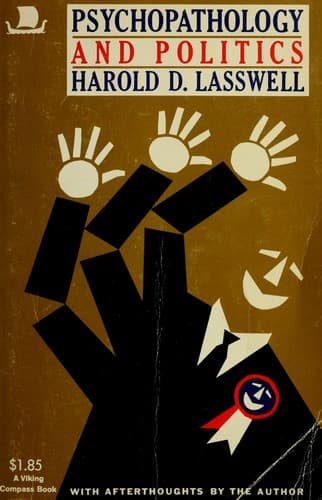
Psychopathology and politicsLasswell, Harold D. (Harold Dwight)
Science
Psychopathology and politics
Lasswell, Harold D. (Harold Dwight)
Personality and politics; Political science; Psychoanalysis; Psychology, Pathological
The technique of therapy consisted in using clues to facilitate the
patient’s search for relief. The problem was to discover the nature
of the patient’s conflict and to volunteer interpretations for the
sake of helping the patient to dare to bring into full consciousness
the unavowed impulse which had once frightened his socially adjusted
self into frantic repression. This involved the interpretation of the
symptom as a compromise product of the patient’s ideal of conduct; and
the out-of-conscious impulse, which, though denied access to the full
consciousness of the sufferer, possessed enough strength to procure
partial gratification. The symptom was thus a symptom of conflict
between the socially adapted portion of the self and the unadapted
impulses of the personality, and the symptom was a compromise between
partial gratification of the illicit and partial punishment by the
conscience. The particular form of the “conflict” depended upon the
traumatic experience and the antecedent history of the individual.
Far more important than these therapeutic elaborations is the shift
in standpoint which made them possible. Since Freud was on the search
for the literal by way of the symbolic, he raised hitherto neglected
manifestations of human behavior to the dignity of significant symbols,
wrote them out, and introduced them into the literature of human
behavior. There could be no sharper illustration of the prepotency of
“mental set” for the seeing of “facts” than the difference between
the clinical reports of Freud and Janet. Freud, convinced that the
eluctable energies of the organism could betray themselves in every
image and in every gesture, painstakingly recorded the dreams and
day-fantasies of his patients. Janet, who continued to assume that
dreams were nonsensical confusions attributable to the diminished
tension of the sleeping organism, seldom made any allusion to dreams.
His pellucid description of grimaces, gestures, sentiments, and
theories of his patients led back to relatively recent moments when the
patient failed of adjustment. This failure of the patient to mobilize
his energies in smooth adaptation to the exigencies of social reality
was then imputed to a defective biopsychical mechanism, to a lowered
“psychological tension,” due to a miscellany of possible causes, among
which was mentioned “the exhaustive effects of emotional excitement.”
Therapy consisted in restoring the capacity of the individual to
mobilize and deploy his energies at the highest “levels” of adjustment.
This was to be achieved by a variety of means--by hypnotic suggestion,
rest in a simplified environment, and the usual repertory of the
psychotherapist.
Public-domain text, read in full here on John Shaqi.
Reviews
Reviews
No reviews yet
Be the first to share your thoughts on this work.
Join the Discussion
Join the discussion
Sign in to leave a comment or review.
Sign InorCreate an account