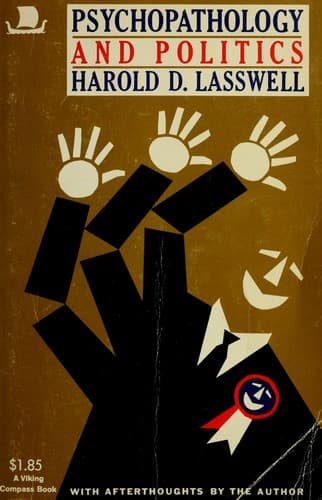
Psychopathology and politicsLasswell, Harold D. (Harold Dwight)
Science
Psychopathology and politics
Lasswell, Harold D. (Harold Dwight)
Personality and politics; Political science; Psychoanalysis; Psychology, Pathological
But the golden flash of psychological insight eluded Janet. At bottom
he had little respect for the concrete reality of the mental life of
his patients. Although he talked the language of psychogeneticism, it
had a poor and not a rich connotation in his mind. I think this is
due to his too exclusive reliance upon hypnotism, for the mental set
of the hypnotist is derogatory to most of the concrete productions
of the patient. The patient, one feels with a shrug, will presently
come to the important experience; why take the superimposed material
too seriously? Then, too, the patient may be put in order by direct
command. Janet relates with some pride how people in the waiting-room
of his office would marvel when a woman, bent nearly double, would be
admitted into his sanctum, presently to emerge, erect and cured--until
the effect wore off.
Freud learned a new respect for the concrete reality of mental life in
his concentrated effort to divine the hidden conflict without resorting
to hypnosis. His weakness as a hypnotist was in a sense the beginning
of wisdom. A patient who is deeply hypnotized is but infrahuman.
Barring commands which do violence to the moral code of the individual,
the subject will passively execute the commands of the hypnotist. The
patient descends from a complicated “nearly normal” person to a waxy
caricature of a human being. The unhypnotized patient of Freud is in
relatively full possession of all the resources of the ordinary waking
self, and must be dealt with as a complex human being.
The widest gateway to psychoanalytic development became the study
of dreams. And here again we are dealing with something which came,
not from laborious reflection upon underlying concepts, but from the
urgencies of the clinical situation. Just as we found that Freud had
taken up a new post of observation in practice before he discovered
its implications in theory, we find that in such a detail as the
investigation of dreams, his theoretical preoccupations contributed
less than his everyday necessities. Freud’s patients continually thrust
their dreams upon him; and he, now in pursuit of clues to what lay
behind, presently took them seriously, and found in them many helpful
indications of unspoken things. He would assist the free-fantasies of
the patient by asking what came into his mind about any detail of the
dream, and he attentively followed the long chains of superficially
meaningless associations.
It began to appear that Freud had stumbled upon, and then brilliantly
elaborated the possibilities inherent in, a new way of using the mind.
He trained his patients in a technique of free-fantasy which they
could subsequently use for themselves as a supplement to the logical
technique which society ostensibly tries to foster. It at once appeared
that he had discovered a method of thinking which was applicable far
beyond the confines of the clinic and which could be added to the
repertory of the mind.
Public-domain text, read in full here on John Shaqi.
Reviews
Reviews
No reviews yet
Be the first to share your thoughts on this work.
Join the Discussion
Join the discussion
Sign in to leave a comment or review.
Sign InorCreate an account