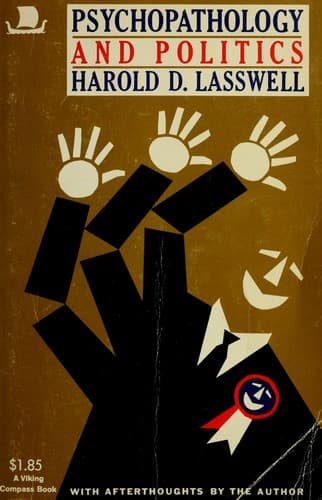
Psychopathology and politicsLasswell, Harold D. (Harold Dwight)
Science
Psychopathology and politics
Lasswell, Harold D. (Harold Dwight)
Personality and politics; Political science; Psychoanalysis; Psychology, Pathological
The interpretation of dreams was the bridge which brought Freud from
the confines of the clinic to the analysis of the whole psychology
of individual development. The dreams of patients and the dreams of
non-pathological persons showed such homogeneity of symbolism that
the gap between the “normal” and the “sick” seemed to close. Popular
lore already furnished a clue to dreams as wish-fulfilments, whether
found in the “well” or “ill,” but popular lore also treated them as
reminiscences, prophecies, and omens, or as confusions, depending on
the transitory context of the moment. Freud had a double orientation
in dealing with the individual. He regarded him as motivated in the
present by impulses which eluded his own consciousness. He regarded
these motivations as having achieved their present form in concrete
historical events in the life of the individual. The nature of the
present could be made clear to the conscious mind if the organizing
episode could be recalled. This recall could be greatly facilitated by
paying special attention to the “irrational” or non-adjustive aspects
of the person’s present conduct. The “irrational” would seem rational
enough if the unacknowledged motives were made manifest, and if the
historical as well as the contemporary allusions were sought after.
Sooner or later the unrecognized motives would disclose themselves in
consciousness, if the individual waited attentively; but the process
could be greatly helped by using a different style of thinking than the
logical.
No one has more dramatically and repeatedly shown the limitations (as
well as the advantages) of logical procedures of thought than Freud.
No one has made a more important contribution to the technique of
supplementing logical thought by other methods of thought than Freud.
This is the aspect of Freud’s work which has immediate and constant
relevance to political as to every other sort of thinking, and to which
it is important to devote more extended consideration.
CHAPTER III
A NEW TECHNIQUE OF THINKING[6]
The prevailing theory is that men who make important decisions in
politics can be trained to use their minds wisely by disciplinary
training in the practices of logical thought. Legal training is
supposed to mold the mind to ways of dealing with the world which
subordinate whim to principle. Formal instruction in the social
sciences is intended to equip the mind for the detached consideration
of social consequences, and everyone agrees that this implies a
large measure of self-awareness for the sake of reducing the play of
prejudice.
Public-domain text, read in full here on John Shaqi.
Reviews
Reviews
No reviews yet
Be the first to share your thoughts on this work.
Join the Discussion
Join the discussion
Sign in to leave a comment or review.
Sign InorCreate an account