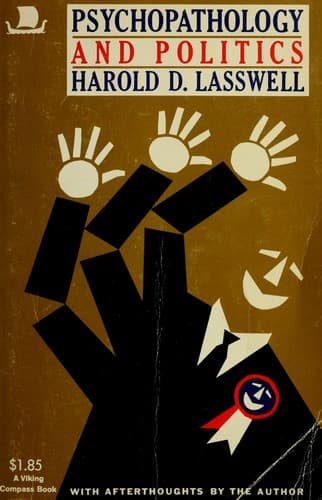
Psychopathology and politicsLasswell, Harold D. (Harold Dwight)
Science
Psychopathology and politics
Lasswell, Harold D. (Harold Dwight)
Personality and politics; Political science; Psychoanalysis; Psychology, Pathological
The nature of logical thought has been carefully examined by an array
of able writers. Their conclusions may be provisionally reported by
saying that logic is a guided form of mental operation. It is not
something marked off from impulse, but a progressive elaboration
and differentiation of impulse. It proceeds by the affirmation of a
starting-point, which is in fact a vague indication of the goal to be
reached, and develops by the criticism of the material which appears
in consciousness according to its relevance to the end in view. If
the judge begins by wanting to settle a controversy consistently with
precedents, he has indicated in advance the shadowy outline of the
desired termination of his efforts. If an administrator wants to reduce
complaints against his handling of the postal service, he starts with
a different mental set from the judge, but, like the mental set of the
latter, his first act is to bring into view the state of affairs which
he hopes to find when he quits thinking. He is accustomed to guide the
operations of his mind by this preliminary characterization of the
terminus sought. No thinker can haul into the center of attention the
material which indicates how the terminal situation is to be attained.
The thinker must wait attentively for whatever appears. If he wants
to deal with such a simple practical matter as getting to the railway
station, and his mind continues to fill with images of the one he left
behind him, his accustomed means of asserting control is to reiterate
the practical end and to hope that he can “keep his mind on” taxicabs
or autobusses. Alternating with periods of reiteration and expectancy
and illumination are episodes of “No” and “Yes,” which evidence the
existence of guided thought.
It would be misleading to stop with this formal description of the
characteristics of logical thinking. Logical thinking is not a
hocus-pocus to be applied here and there and everywhere. The previewing
of events presupposes familiarity with the sorts of events to which
the previewing relates. It usually involves analysis of the contingent
future in the light of analogies with the past, which is simply a
means of refining general familiarity through systematic methods of
inspecting reality. General knowledge of lending and borrowing must
be supplemented, for many purposes, by detailed examination of the
quantitative dimensions of various routines. The precise nature of the
relationship between changes in the rediscount rate and the price of
call money requires analysis far beyond impressionistic familiarity.
Public-domain text, read in full here on John Shaqi.
Reviews
Reviews
No reviews yet
Be the first to share your thoughts on this work.
Join the Discussion
Join the discussion
Sign in to leave a comment or review.
Sign InorCreate an account