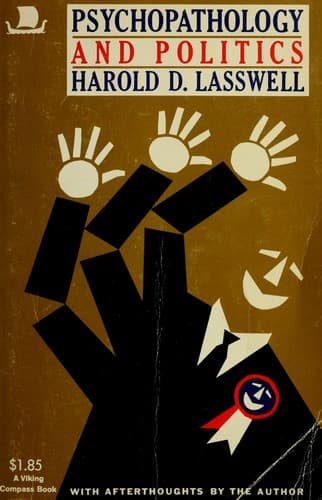
Psychopathology and politicsLasswell, Harold D. (Harold Dwight)
Science
Psychopathology and politics
Lasswell, Harold D. (Harold Dwight)
Personality and politics; Political science; Psychoanalysis; Psychology, Pathological
There need be no illusion that the specification of the terminal
situation provides an immovable constant for thought. We can imply, as
we have implied, that logical thinking begins by sketching a figure on
the canvass and leaves the details to be filled in during the course of
the thinking. But the starting-point is often subject to many shifts,
and the initial sketch is more or less subject to remaking. The judge
who starts in pursuit of consistency-with-precedent characteristically
must add conformity-to-principles-of-policy. A plurality of ends is
always involved, and usually appears.
Everybody knows that the pluralism of ends goes far beyond “official”
ends. A sophisticated and discerning judge may discover an embarrassing
conflict in the controlling precedents, and cast about for other social
purposes than conformity-to-precedent to guide him. He may scrutinize
the principal economic, cultural, and political changes in the society
in which he operates, and discern the appearance of a new set of rising
dominant values, and decide to diminish the cost of social change by
seeking to facilitate their introduction. If this hypothetical judge
believes that he should not consciously enact his private prejudices
into law, and if the social values are so confused that uncertainty
rules, the judge is well advised to flip a coin (in chambers) and
govern his decision accordingly. If the judge finds himself favorably
disposed toward any alternative to begin with, he will take himself
as an object of investigation to determine the extent and origin of
his prejudice. His logic thus involves the use of self-scrutiny for
the exposure of private values which load the dice for or against
a particular point of view. Besides the values which are “public,”
there are complicating values which are the residue of one’s “private”
history.
All these points are stressed in greater or less degree in the current
writing on the use of the mind. The avowed purpose of our professional
schools is to increase the amount of logical reflection in the world,
and the set complaint is that people somehow or another manage to think
very clumsily. In spite of our best efforts to disseminate logicality,
people are always “letting their prejudices run away with them,” even
when they have a baggage of good intentions.
The stock alibi for the failure of the schools to improve the
character of thinking among those who hold positions of power is
that the human mind offers a perverse opacity to the rays of reason.
Somehow or other our training doesn’t take; but this is attributed
not to the deficiencies of logic but to the resistances to it. All
this is reminiscent of the reply of the Christian to the taunt that
Christianity has failed. He says that Christianity isn’t to blame, but
the lack of it. The logicians say that the cure of bad logic is more
and better logic. If the human mind refuses to be educated, that’s just
too bad.
Public-domain text, read in full here on John Shaqi.
Reviews
Reviews
No reviews yet
Be the first to share your thoughts on this work.
Join the Discussion
Join the discussion
Sign in to leave a comment or review.
Sign InorCreate an account