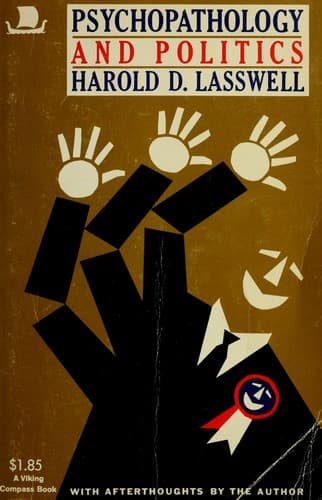
Psychopathology and politicsLasswell, Harold D. (Harold Dwight)
Science
Psychopathology and politics
Lasswell, Harold D. (Harold Dwight)
Personality and politics; Political science; Psychoanalysis; Psychology, Pathological
Our thesis is that our faith in logic is misplaced. Exclusive
emphasis upon logic (even where logic is adroitly used) incapacitates
rather than fits the mind to function as a fit instrument of reality
adjustment.
The supposition that emotional aberrations are to be conquered by
heroic doses of logical thinking is a mistake. The absence of effective
logic is a symptom of a disease which logic cannot itself cure. We have
been misled by supposing that the mind can rely upon a single technique
of operation when this isolated technique has serious limitations.
A totally different technique of thinking is needed to get on with
the task of ridding the mind of the distorting results of unseen
compulsions. Since our schools have found no place for the cultivation
of this additional technique of thinking, our judges and administrators
and policy-makers are turned loose on the world armed with faith in
logic and incapable of making their minds safe for logic. Logical
thinking is but one of the special methods of using the mind, and
cannot itself achieve an adequate inspection of reality because it is
unable to achieve self-knowledge without the aid of other forms of
thinking.
The technique of free-fantasy offers many points of contrast with
logical thinking. It is unguided rather than guided association. From
a given starting-point, no effort is bent toward the exclusion of the
trivial, the trite, the embarrassing, the filthy, the nonsensical. The
mind is permitted to run hither and yon. It is hospitable to everything
which germinates in the mind, and is subject only to the effort to
steer clear of the molds of logical thinking. There is no specific
definition of an objective, and no intermittent intervention in the
flow of material to register its pertinence or impertinence to this
rather specific objective.
Free-fantasy is not to be confused with free word associations which
begin with simple stimulus words and end when the first few words
which pop into the mind are put down. Free-fantasy is not a momentary
relaxation of selective criticism, but prolonged emancipation from
logical fetters.
Free-fantasy differs from the ordinary daydream, the night dream, and
the visions which arise in sleeping or waking by the circumstance that
it is embarked upon with the vague, generalized purpose of rendering
available new subject matter for logical thought. The frequent
interventions which characterize logical procedures are suspended,
the better to serve the ultimate purposes of reality adjustment.
Daydreaming which is not used for this general purpose does not
represent a technique for using the mind.
Public-domain text, read in full here on John Shaqi.
Reviews
Reviews
No reviews yet
Be the first to share your thoughts on this work.
Join the Discussion
Join the discussion
Sign in to leave a comment or review.
Sign InorCreate an account