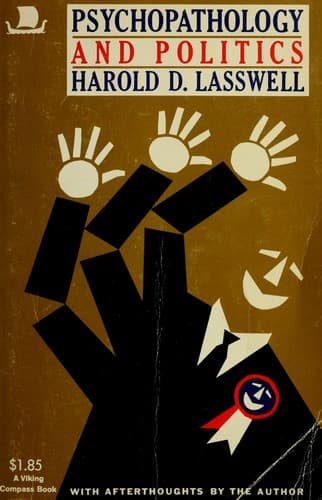
Psychopathology and politicsLasswell, Harold D. (Harold Dwight)
Science
Psychopathology and politics
Lasswell, Harold D. (Harold Dwight)
Personality and politics; Political science; Psychoanalysis; Psychology, Pathological
The ultimate paradox of logical thinking is that it is self-destroying
when it is too sedulously cultivated. It asserts its own prerogatives
by clamping down certain restrictive frames of reference upon the
activity of the mind, and presently ends in impoverishing the activity
which it purports to guide into creative channels. It becomes
intolerant of the immediate, unanalyzed, primitive abundance of the
mind, and by so doing destroys its own source.
More seriously, too, for the mind which is engaged with social life,
logical procedures exclude from the mind the most important data about
the self. Directed thinking, whether about the self or something
else as an object, is impatient of the seemingly trivial, and this
impatience with the seemingly trivial is the rationally acceptable
guise in which the impulse to avoid rigorous self-scrutiny gets itself
accepted. The mind which is freely fantasying produces distasteful
evidence of the facts about the self which the socialized self wants to
avoid. This is why free-fantasy is not learned by rote, but achieved
through trying experiences, usually under prolonged supervision.
There are wide individual differences in acquiring the technique
of free-fantasy. Logical controls are often so gradually released
that progress is almost imperceptible for several weeks of daily
contact with a psychoanalytic interviewer. Frequently, of course,
the logical controls fall away quite rapidly, and the exposure of
the underlying preoccupations proceeds apace. Freud developed the
technique, and drills his subjects, largely in relation to their
dreams, but this is in no sense its exclusive application. The purpose
of the psychoanalytic interview is not served if the patient is merely
relieved of a few annoying symptoms; its purpose is to equip him with
a means of handling his mind which will enable him to go it alone. In
developing the free-fantasy procedure, Freud added a powerful tool
to the repertory of those who would use their mind with some hope
of disentangling themselves from the compulsive domination of many
vestigial remains of their “private” histories.
It is quite possible to train people to use the free-fantasy method
with considerable success and to outfit them with a device which they
can use in the ordinary problems of professional and private life.[7]
The instances which I shall presently adduce are from the fantasies
which were produced by a judge in the course of a series of interviews
which he undertook after his curiosity about the method had been
aroused by the therapeutic treatment of a member of his family. Any
specific allusions are disguised.
Public-domain text, read in full here on John Shaqi.
Reviews
Reviews
No reviews yet
Be the first to share your thoughts on this work.
Join the Discussion
Join the discussion
Sign in to leave a comment or review.
Sign InorCreate an account