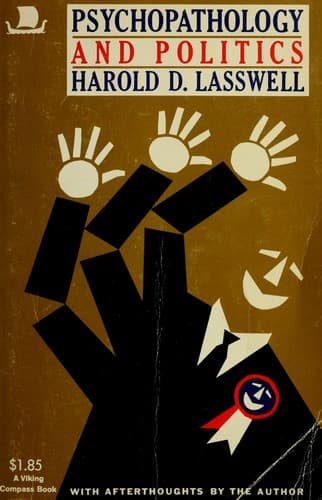
Psychopathology and politicsLasswell, Harold D. (Harold Dwight)
Science
Psychopathology and politics
Lasswell, Harold D. (Harold Dwight)
Personality and politics; Political science; Psychoanalysis; Psychology, Pathological
One day the judge commented at the beginning of the interview that
a certain attorney irritated him in some unexplained way. He found
himself acutely conscious of his own prejudice against the man, and
in trying to deal fairly with him often leaned over backward and
showed him an embarrassing favoritism in sustaining his objections.
There was always a struggle to hold the balance even. This seemed to
indicate the conspicuous operation of some unrecognized set of motives
in relation to this particular individual. The judge, who was already
partly skilled in the use of free-fantasy, began to report whatever
came into his mind at the mention of the attorney, without regard to
logic or scruple. “Cigar smoke ... black cigar ... vile and pungent
and stuffy ... corridor ... courtroom ...,” and so on and on. The word
“corridor” reappeared several times in the course of his associations,
and the interviewer initiated a new chain by using the word as a
stimulus. After some time, there came up a vivid memory of an incident
in the corridor of the law school where the judge had studied. A
fellow-student, who was a man with a great reputation as a promising
mind, dropped cigar ashes by accident on the judge’s overcoat. The
judge remembered his angry impulse to “sock” the offender, an impulse
which he instantly subdued, and that he accepted the apology, which
seemed to end the incident. Associations were continued to find why the
brilliant rival had so incensed the judge, and the trail led back to
certain incidents and reveries in early adolescence, but this material
is not relevant here. The connection of his hostility toward his former
rival with the attorney before him was due to one of the attorney’s
mannerisms, which recalled the way the student had flecked ashes
off the end of his cigar. When this tie was exposed, the compulsive
animosity and the overcompensatory reactions disappeared from the
attitude of the judge in relation to the attorney.
Public-domain text, read in full here on John Shaqi.
Reviews
Reviews
No reviews yet
Be the first to share your thoughts on this work.
Join the Discussion
Join the discussion
Sign in to leave a comment or review.
Sign InorCreate an account